The Nourishing Home

living healthier lives in service to the King!

  • Home
  • About
    • About TNH
    • Contact
  • Meal Planning
  • Health & Wellness
    • Real Food Basics
  • Whole30
  • GF Recipes
    • Whole30
    • Breakfast
    • Lunch
    • Entrées
    • Slow Cooker
    • Soups & Stews
    • Sides & Salads
    • Snacks
    • Desserts
    • Kids in the Kitchen
  • My Cookbook
  • Subscribe

Cook Once, Eat Twice or More! {Simple Strategies to Save Time in the Kitchen}

By Kelly · 8 Comments

Strategies for Saving Time in the Kitchen

Throughout the year (and especially when our schedules get over busy), one of my favorite time-saving techniques is to “Cook Once, Eat Twice or More!” This basic meal planning strategy really helps you save time and work more efficiently in the kitchen, which is why I always incorporate it into each of my weekly meal plans.

In a nutshell, you cook (or simply prepare) a double portion of something and save half for a future meal.

How does this save time? Well, think of all the work that needs to happen to get a healthy meal on the table – there’s the preparation time, cooking time, and of course, everyone’s favorite – clean-up time! So, if you make double of something during one cooking session, you’re being more efficient because you don’t have to repeat those same exact steps twice.

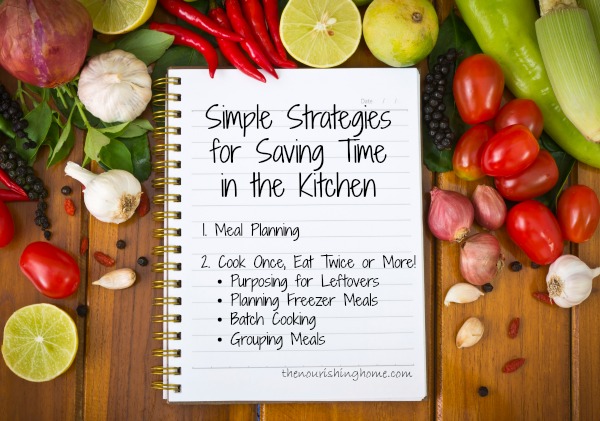
Cook Once, Eat Twice or More can take several forms, such as:
• Purposing for Leftovers
• Planning Freezer Meals
• Batch Cooking
• Grouping Meals

We’ll cover each of the above principles in detail below. Because once you adopt these time-saving strategies, I’m certain they will become your newfound favorite tips, especially when planning ahead for busy days, when time in the kitchen is limited.

FREE Gluten-Free, Family-Friendly Meal Plans:
Just a friendly reminder, that I provide free monthly meal plans over at The Better Mom blog. Each week’s meal plan contains delicious family-friendly GF recipes utilizing a time-saving method to make getting a healthy dinner on the table a snap! I highly recommend you pop over to The Better Mom and download these free meal plans.

How to “Cook Once, Eat Twice or More!”

As with most things related to saving time in the kitchen, it starts with your Meal Plan! So if you’re new to meal planning, please view my Mastering Meal Planning presentation, or visit the Meal Planning section of this to help you get started.

So here’s how it works … as you’re creating your weekly meal plan, consider what meals you could cook (or simply prepare) a double batch of and freeze or refrigerate for future use. Then schedule time on your meal plan (or on your meal planning prep day) to utilize one of the following Cook Once Eat Twice or More principles, such as:

Purposing for Leftovers

One of the easiest and most common time-saving strategies is to intentionally plan for leftovers. Simply double an entire recipe, cook it and then refrigerate/freeze the leftovers for a future meal. In general, soups, stews, casseroles, and pasta dishes make excellent leftovers. In fact, some dishes taste even better as time passes, because the flavors have had a chance to meld.

And of course, there’s also the option of “repurposing” leftovers, which simply means using your leftovers to create a slightly different meal. For example, leftover ground meat from taco night, can easily be used to make a Taco Salad for lunch. Or a bit of leftover grilled chicken can be turned into a delicious Greek Salad Wrap. Leftover black beans can be used to make a fun Rainbow Bean Dip lunch. And the great thing is, repurposing leftovers not only saves time, it saves money too!

Freezer-Meals

Planning Freezer Meals

With freezer meals, you simply spend a little extra time upfront prepping and freezing meals for future use. This is a popular strategy especially with crockpot meals, casseroles, soups, stocks and stews.

I find the most efficient method is to prepare (and cook, in some cases) two or more of the same meal in one session. Then use one of the meals for dinner that night, and freeze the other(s) for future quick-n-easy dinners.

One of our favorite crockpot meals is Sweet & Spicy Crockpot Chicken. This is a great example of a meal that can easily be prepped ahead and frozen. Then it’s as simple as removing the ingredients from the freezer, popping them into the crockpot and coming home later to a delicious, healthy dinner.

Another example is my Turkey Times Three (T3) strategy for making three great ground turkey based recipes all at the same time and then freezing them to have ready-to-go meals on busy days.

And yet another example, is doubling casserole-style meals. Whenever I plan to make Chicken Parmesan, I always make two at the same time. I cook one for dinner that night and freeze the other for a future meal. Or in this case, you can make a double batch of just the chicken and use half to make Chicken Parmesan and the other half can be frozen for use as Chicken Tenders for a future meal.

Sidebar: If you participate in any meals ministries, doubling casseroles and freezing them is a great way to always have an extra meal on hand for a family in need!
Batch-Cooking

Batch Cooking

Batch cooking is really just another way to describe intentionally planned leftovers – you simply make large quantities of a food that can be stored for later use. For example, on the weekends, I like to make double or triple batches of pancakes, french toast or muffins, which I can then freeze and use for quick breakfasts during busy weekday mornings.

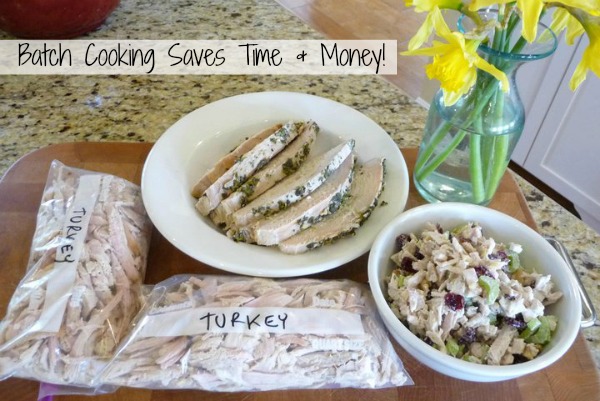
One of my favorite batch cooking strategies is to simply double or triple a main ingredient in a meal (such as meat, poultry or beans) and save half to create a future meal that uses the same main ingredient. For example, as shown in the photo above, I intentionally made a large 6 lb. roast turkey breast for dinner. Then, divided-up the leftovers for 4 more meals: Sliced breasts for leftovers night, two 2-cup portions of shredded turkey (frozen for future use in turkey noodle soup and turkey pot pie) and turkey salad for lunch.

In addition, whenever I make Stovetop Chicken Stock, I always make two batches instead of one. That way, I end up with lots of stock and meat that I can freeze and use to quickly make other soups and meals in the future.

And don’t forget your veggies! When having grilled veggies as a side dish, plan to grill extra and use them to make Veggie Quesadillas for lunch or dinner the next day, or add them to a salad or sandwich … these are just a few ideas to get you started.

Example Meal Plan using Batch Cooking

The yellow highlighted meals demonstrate how I group meals with the same main ingredient on my meal plan so I can “Cook Once, Eat Twice or More.” The pink highlighted meals show how I further use batch cooking and “purposing for leftovers”to save even more time in the kitchen. With just a little planning and practice, you’ll be saving lots of time too!

Grouping Meals on Your Meal Plan

A simple twist on the batch cooking concept is a strategy I call “Grouping Meals.” How it works is, you take a look at your Master List of Meals and consider what recipes contain the same main ingredient. Then, you intentionally schedule on your meal plan to serve at least 2-3 of those meals with the same main ingredient over the course of the week. (Obviously, the busier the week, the better to have more meals with the same main ingredient.)

For example, whenever I plan make our favorite Grilled Pineapple Chicken (or Grilled Herb Chicken) recipe, I also take a look at other meals that use grilled chicken and plan a couple of those meals on my meal plan as well. That way, I can simply double (or triple) the amount of chicken I toss on the grill. Then, I refrigerate or freeze the extra grilled chicken for use in the other grilled chicken based meals on my meal plan.

To better illustrate Grouping Meals, take a look at the meal plan above. You will see the yellow highlighted meals each use grilled chicken as the main ingredient. So by planning several meals that use the same main ingredient – grilled chicken in this case – I can save a lot of time by simply preparing and grilling all of the chicken needed in one cooking session.

Honestly, it takes very little extra time to incorporate batch cooking into your schedule. Yet, this simple step saves a ton of time later since you only have to prep, cook and clean-up once, rather than two or three separate times. And of course, it also saves a significant amount of time when you go to prepare other meals using this same batch-cooked item.

Applying these “Cook Once, Eat Twice” concepts across the board

Now that you know these time-saving secrets, start thinking about how you can apply them to many of your favorite recipes, such as casseroles, soups, meats, poultry, and side dishes.

As you start looking over your Master List of Meals, it will be exciting to see how you can group meals with the same ingredients together to make preparation time and cooking time faster, easier and less stressful via batch cooking.

Remember to also look for recipes that make great freezer meals, and schedule time to make two of these meals during one cooking session – one for now and one to freeze for later. That way, you can start creating a nice stockpile of quick freezer meals for back-up on nights when you are limited on time.

And of course, one of the easiest ways to save time is to simply plan for leftovers (or repurpose them).

As always, if you have any questions, please feel free to leave a comment or send me an email. And if you have some meal planning success stories or time-saving tips to share, please leave a note below.

Remember, “Whatever you do, do it all for the glory of God!” (1 Cor 10:31) So have fun and give all praise and glory to the Lord as you strive to provide healthy, home-cooked meals for your family while saving lots of time in the process!

You Might Also Like:

Meal Plan Monday: November 25 – December 8
Meal Plan Monday: July 9–22
Meal Plan Monday: November 11–24

Filed Under: Mastering Meal Planning, Meal Planning ·

8 Tips for Real Food on a Budget {and how to set healthy living goals}

By Kelly · 16 Comments


One of the top questions I’m asked, relates to the expense of eating Real Food. In a nutshell, inquiring minds want to know: “How does eating real food impact your budget?”

Of course, there’s no simple answer to this question, as there are many variables that need to be considered. My goal in this article, is to outline many different ways you can adopt a healthy real food lifestyle, while still keeping your budget in check.

And, at the end of this article, I’ve included a list of resources to help you further explore and implement some of the tips and suggestions listed below. In addition, I’ve provided a follow-up post “Buy Big, Save BIG,” which provides an example of how buying in bulk can truly help families save money.

1. Get a Handle on Your Current Food Budget

Before you can accurately determine how much making the switch to real food is going to impact your budget, you have to determine what you are currently spending each week/month on food? What about eating out? It’s critical to include what you spend on eating out with family and friends, daily/weekly lunches out with your office colleagues, and special treats, like trips to your favorite frozen yogurt place, Starbucks, etc. Most people are shocked when they discover how much they are spending each week/month in eating out and/or ordering take-out. It’s important to keep in mind that the more you stop eating out, the more you will improve your health, and the more you will free up your budget to purchase real food, that’s real nourishing!

2. Set Goals/Determine Priorities and PRAY!

I can’t stress how important this is! Once you get a handle on how much you’re currently spending on food, including eating out, it’s important to sit down with your spouse and discuss your goals/priorities together.

However, before we go any further, I want to be sure to address the importance of being a good steward. Followers of Christ are called to be faithful stewards – using all of our various resources for His glory. My time, money and talent are God-given gifts – so in reality nothing is mine, it is all His. So my first priority is nothing less than to give sacrificially of my time and money in serving God. Everything else has to come second!

So I encourage you to prayerfully consider how God wants you to use the resources He has provided to you and your family. Seeking the Lord in prayer should be the first step you take before you and your spouse set any goals or priorities of any kind. Ask Him for His will in this first, before moving forward in setting goals/priorities for improving your family’s diet.

And when you are ready to move forward … please don’t try to change everything at once, it will not only be overwhelming, but it will also be expensive. Taking time to prioritize, and make one change at a time, will help you to keep a close eye on your budget and also help you to not become overwhelmed.

Ready to get started on your real food journey? Here are some tips:
• List out your goals for healthy eating
• Talk to your spouse and pray about them together
• Prioritize – put your goals in order of priority
• Focus – select one of your top priority goals
• Make an action plan – list out the steps you will take to meet that goal, including setting a grocery budget and exploring options to keep your budget in check. (I cannot recommend enough my dear friend Tiffany’s “How to Create a Frugal Grocery Budget Series” – it’s a great way to help you to set a do-able food budget.)
• Just do it – start putting your action plan into action!
• Analyze your success – how’s it going with meeting your goal? What obstacles are you facing, what can you tweak or change to be more efficient and save money?
• Keep on moving – once you have successfully achieved a goal, initiate an action plan for your next goal, and keep on building from there. It’s slow, steady progress that results in long-term change!

3. Meal Planning Saves Money!

Whether you’re trying to reduce the frequency and expense of eating out, or you’re trying to save time and money on the meals you’re already making at home, it’s important to get savvy with meal planning. Mastering Meal Planning will not only help you to more efficiently get a healthy meal on the table, but it will also help to reduce the expense of eating at home. In addition, meal planning enables you to take advantage of other important money-saving strategies like repurposing leftovers and the time- and money-saving strategy of Cook Once, Eat Twice or More.

4. Beyond Organic: Get to Know The Clean 15

Most people know that eating organic is the ideal. Organic foods are free of harmful pesticides, herbicides and other toxic chemicals; they contain more nutrients; contribute to a healthier environment; and of course, they’re GMO free.

However, there’s also no doubt, organic produce is more expensive. We all know that you can’t put a price on good health, however, if you’re on a tight budget, it’s nice to know that there is a little wiggle room. It comes in the form of two great resources called: The Clean 15 and The Dirty Dozen.

The Clean 15 is a list of the top 15 non-organic produce items that are considered safe to purchase, whereas the Dirty Dozen are the top 12 foods that you definitely want to be sure to purchase as organic in order to avoid high levels of toxins. Knowing which non-organic produce is safe to purchase will help you save money without compromising your family’s health. The great news is, the Environmental Working Group provides a free downloadable pocket guide with all of the details.

IMPORTANT NOTE: The “Clean 15” shoppers guide is based on the highest and lowest pesticide levels on produce. However, it does NOT cover another important health issue – GMOs. For a free shoppers guide about how to avoid GMOs, please visit Non-GMO Shopping Guide. If you’re unfamiliar with GMOs and why you and your family should avoid them, or if you are interested in knowing the “secret” PLUs that reveal which produce is GMO, please check out What are GMOs & How to Avoid Them.

5. Convenience Verses Saving

Another great way to save money is to be aware of convenience versus saving. Those convenient premade/prepackaged foods that we’ve become completely dependent upon in modern society don’t come without a price. It’s not just the poor nutritional value that costs us, it’s also the price-per-serving that is oftentimes much more expensive than when we commit to making these same products ourselves using real food.

For example: Organic whole milk yogurt costs from $3-5 for a 32oz. container. A loaf of GF bread runs around $5-7. A box of “healthy” organic cookies runs about $4-5 per package. However, these items, homemade with healthy real food ingredients, will not only save you money, but are also substantially higher in beneficial nutrients and do not contain any unwanted added preservatives or fillers (“natural” or not).

Additionally, precut and packaged fruit and veggies are generally much more expensive than if you take the time to cut them yourself. For example, a container of precut pineapple at Trader Joe’s runs about $3.50. However, a more frugal option is to purchase a 3 lb. whole pineapple at the usual going rate of 99¢ a pound and slice it yourself, because for just $3.00 and five minutes of your time, you will get nearly double the amount of pineapple!

As a personal example, one of the first steps I took in eliminating packaged foods was to stop buying boxed cereals (which number one are not healthy, no matter what the label says and number two are expensive). When it comes to “cereal,” the grain lovers in my home eat homemade soaked granola and breakfast porridges, such as soaked oatmeal. (Personally, since I’m GF, I enjoy a delicious homemade grain-free “granola” blend made from various nuts, seeds and dried fruits.)

In addition, I make all of our healthy baked goods and sweet treats from scratch (i.e. cookies, muffins, cakes, biscuits, breads). I also make my own Kombucha, salad dressings and more – and WOW do I save big for my time invested in making these items. (Visit the Healthy Recipes section of this website for lots of homemade recipes.)

So, eating real food on a budget comes down to a barter system between time and money. It’s not always feasible to completely make everything from scratch. Believe me, I know! But, if you invest a little extra time by making many of the key staples in your diet, you will save money and even better, you and your family will also enjoy healthier foods. So if you really want to reduce your food budget, you need to take a look at your time, and determine how much time you have to save even more money by making more of your family’s food.

6. Buy Big, Save Big

Once you find a staple real food item that you like and plan to use frequently, be sure to buy it in the BIGGEST size you can afford and will use before its expiration. Larger-sized containers are almost always significantly less expensive per ounce, than their smaller counterparts.

Take honey for example: If I purchase the largest size (48oz) at the market, I will pay 26¢ less per ounce than if I purchase the 16oz size. So if I use 16oz of honey each week, that would equate to me saving more than $4.00 a week on honey alone.

Flour (whether whole grain or grain free) is another great example. I highly recommend buying your flour in bulk sizes and storing it in the freezer (up to 6 months) to maintain freshness. You can even divide the flour into smaller portions, if you’d like, so you can keep the majority in the freezer and have some on hand in your pantry for ease of use.

One of the best ways to save BIG, is to buy direct from the manufacturer in bulk. Even with the shipping, it’s oftentimes substantially less than grocery store/health food store prices. Especially if they run sales.

Even better is if you can join a co-op. There are many out there and I am blessed to be part of a co-op through Azure Standard. I’m completely thrilled, because many of the products are significantly less expensive than store prices, and with a co-op you don’t have to pay shipping! So now, instead of paying $8 per pound online for my blanched almond flour, I pay just $5.75 per pound through Azure Standard! That’s a savings of $2.25 per pound – what a blessing!

Another similar “buy big” concept is to buy more when it’s on sale! In other words, if there is an item that you use regularly and it goes on sale, buy as much of it as you know you’ll use before the expiration date. For example: I found my favorite brand of pure maple syrup on sale. Well, not only did I save money by buying the larger size container. I also saved money because the larger size was on sale. So I bought three of the jumbo-sized containers on sale and saved $3 each per container. I know that doesn’t seem like a lot ($9). But every dollar (or penny for that matter), adds up. And if you know you are going to use it, you might as well save as much as you can!

Be sure to check out my Buy Big, Save Big: Real Life Example article for a cost comparison of four common real food staples to help you discover how buying BIG results in significant cost savings!

7. Buy Local Produce

Next to organic, pasture-fed meats, fresh produce can be one of the top budget breakers. However, a great way to enjoy more fresh organic produce, while still saving money, is to buy local. I highly recommend that you take a trip to a local Farmers Market or Farm Stand and compare prices with your favorite whole foods market. You may be surprised to find some great deals!

Another money-saving option for many families is to join a CSA … It’s important to note that joining a CSA may require you to be a bit more flexible, as the boxes generally contain a set selection of seasonal produce and there may be limited ability to pick and choose what you’d prefer. So a CSA may not be the best option, if you have a family of picky eaters.

IMPORTANT NOTE: When purchasing organic produce at a farm stand or anywhere, be sure to look for the certified organic label (sticker) on the produce to ensure that what you are paying for is truly certified as organic.

8. Plant a Garden

Planting a garden and growing some of your favorite organic produce is definitely a budget-friendly option. And even if you don’t have a green thumb (or the real estate), consider starting with a simple herb container garden. I couldn’t believe it when I realized how much money I could save by something as simple as cultivating an herb container garden.

Let’s do the math … It costs about $2 for one small box of a fresh organic herb, like rosemary for example. By purchasing the boxed herb, you get 1-3 meals out of it, and then you have to buy another box. However, you can buy an organic rosemary plant at a local nursery for virtually the same price and enjoy free rosemary thereafter all year long! Saving just $2 a week for a year on just one variety of fresh herb equals $104. Now imagine if you grew all of your favorite fresh herbs! (That’s what I call saving money!)

And depending on how adventurous you are, you can take it even further depending upon your time and resources. This spring, my boys and I are planning to start a strawberry container garden to grow some fresh organic strawberries. It will be fun to learn how to grow strawberries and perhaps, depending on our yield, make some homemade strawberry ice cream together!

One final word of encouragement …
It’s important to not allow healthy eating or maintaining a budget to become an area of over-importance and stress in our lives. Eating healthy should not break the bank and it should not become an idol – something we pursue rather than whole-heartedly worshipping and trusting God. He knows what we need and has promised He will provide for us (Matthew 6:26) and He also reminds us that what we really need is to seek true nourishment only found in His Word and in sweet communion with Him (Matthew 4:4).

Helpful Resources

Online bulk flour and other staples:
• Azure Standard
• Bob’s Red Mill
• Honeyville Brand Blanched Almond Flour

Consider joining a co-op or starting one:
• Azure Standard
• Local Harvest Food Co-ops

Shop at a Local Farmers Market:
• Certified Farmers Markets in Orange County, CA
• Search for a Farmers Market Near You

CSAs/Organic Farm Stands in Orange County, CA:
• South Coast Farms
• Tanaka Farms

Additional Help for Creating a Real Food Budget:
• “How to Create a Frugal Grocery Budget Series” by budgeting guru friend Tiffany at Don’t Waste the Crumbs
• Real Food on a Real Budget (e-book) by Keeper of the Home


You Might Also Like:

Top 10 Grocery Budgeting Tips of 2014
Stocking Your Pantry/Fridge with Whole Food GF Cooking Essentials
The Secret to a Healthy Grocery Budget: Keeping Your Receipts

Filed Under: Real Food Basics, Real Food on a Budget ·

Real Food on a Budget, Part 2

By Kelly · 8 Comments


Buy Big, Save Big:  Real Life Example 

This article is a follow-up to “8 Tips for Real Food on a Real Budget” and provides a cost comparison of three items as an example of how you can save money by buying large/bulk sizes. so, if you’re looking for ways to curb costs and better manage your budget, I highly recommend reading 8 Tips for Real Food on a Budget.

How buying BIG will save you money:
For comparison purposes, let’s say I use approximately 15 ounces of coconut oil, 16 ounces of honey and a pound of blanched almond flour each week. The cost per week for these four items would be $30.91 per week, if I am buying just what I need for the week (i.e. small size containers).

However, if I started buying the largest size available for these items (that I could reasonably use before the expiration date), then I would actually save a significant amount of money.

Let’s compare costs and see how much money we can save per week on just these four items by buying larger/bulk sizes at Mother’s Market – a local whole foods type store in CA (please note these prices reflect the current costs at the time this post was written):

Coconut Oil
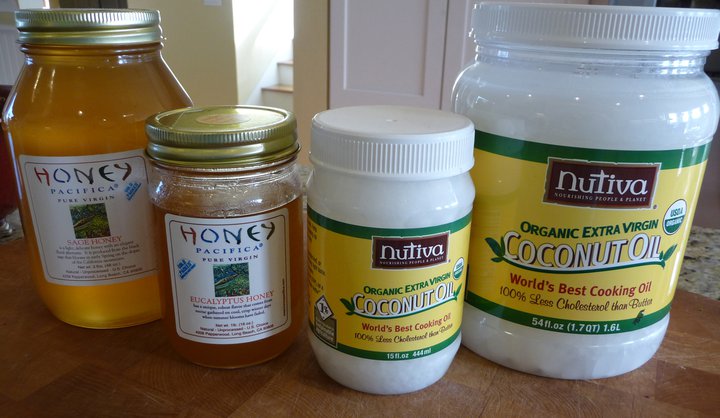
Small size (15oz) Nutiva coconut oil is $0.69 per ounce
Large size (54oz) Nutiva coconut oil is $0.47 per ounce
Savings= $0.22 per ounce

Raw Honey
Small size (16oz) Pacifica honey is $0.61 per ounce
Large size (48oz) Pacifica honey is $0.35 per ounce
Savings= $0.26 per ounce

Blanched Almond Flour
Small size (16oz) Bob’s Red Mill blanched almond flour is $10.80 per pound
Large size (5 lbs) Honeyville blanched almond flour is $6.72 per pound
Savings= $4.08 per pound

Buy Big, Save BIG!
So as you can see from the above cost comparisons, by buying larger/bulk sizes for just these three items on my shopping list, my cost savings would be about $11.54. So, per month I’d save about $46.16 and per year I’d save a minimum of $553.92.  So when you do the math, it’s easy to see that in general, buying BIG is definitely the way to save BIG!

Join A Co-op & Save Even More!
I am so grateful to be in a local Azure Standard co-op. It has really helped me and my family trim down our food budget. Just as one example, I can now purchase Bob’s Red Mill blanched almond flour for just $21.35 for a 5 lb. bag. That is $6.53 less per pound than the same brand at my local market, and it’s $2.45 per pound less than what I was paying for it online.

So buying in bulk either at your local market, or via online, or even better, through a co-op, is a great way to help you trim costs on your food bill. (HOW DO I FIND A CO-OP IN MY AREA? One of the best ways is to contact your local Weston A Price Foundation Chapter and speak with the chapter leader. He/She will be able to provide you with information about any local co-ops that exist, as well as other helpful real food resources in your area.)

Again, buying larger sizes, or in bulk, is just one example of the many ways you can help curb costs to maintain your budget while enjoying healthy real foods. Employing the many other tactics outlined in “8 Tips for Real Food on a Real Budget” will also help you to further keep your budget in check.

Happy savings! Joyfully Serving HIM, Kelly

You Might Also Like:

What are GMOs? (and how to avoid them)
8 Strategies for Saving Money at Farmers Markets
5 Frugal Ways to Save on Groceries without Using a Calculator

Filed Under: Real Food Basics, Real Food on a Budget ·

  • « Previous Page
  • 1
  • …
  • 168
  • 169
  • 170
  • 171
  • 172
  • …
  • 182
  • Next Page »

My New Cookbook is Here!

Welcome to The Nourishing Home!

I’m so glad you’re here and want you to feel right at home! My heart in creating this blog is to help you by sharing helpful meal planning strategies and nourishing GF recipes that are healthy, easy and delicious with thanksgiving to God! [Read More …]


All content (recipes, photos, posts, etc.) on this site is the creative property of Kelly Smith. You are welcome to share a photo via social media, as long as it contains a link back to the corresponding recipe or post from this site. However, you may not republish a recipe in its entirety in any form. For questions, or for permission to use a photo or recipe, please contact me via email at [email protected]. Thank you!

Please Note: All content (recipes, photos, text, etc.) on this site is the creative property of Kelly Smith of The Nourishing Home. You are welcome to share a photo via social media, as long as it contains a link back to the corresponding recipe from this site. However, re-publishing a recipe in any form is strictly prohibited. Additionally, please refrain from adapting recipes without properly linking back to the original recipe, and keep in mind that simple substitutions do not constitute an adapted or original recipe. For details regarding recipe copyright law, please visit the Food Blog Alliance.
The Nourishing Home is a participant in the Amazon Services LLC Associates Program, an affiliate advertising program designed to provide a means for sites to earn advertising fees by advertising and linking to amazon.com.

Privacy Policy
DMCA.com

Copyright © 2026 · All Rights Reserved · The Nourishing Home · Artwork by Nancy Panaccione · Site Design by Deluxe Designs · Log in
