The Nourishing Home

living healthier lives in service to the King!

  • Home
  • About
    • About TNH
    • Contact
  • Meal Planning
  • Health & Wellness
    • Real Food Basics
  • Whole30
  • GF Recipes
    • Whole30
    • Breakfast
    • Lunch
    • Entrées
    • Slow Cooker
    • Soups & Stews
    • Sides & Salads
    • Snacks
    • Desserts
    • Kids in the Kitchen
  • My Cookbook
  • Subscribe

Slow-Cooker Greek Chicken

By Kelly · 21 Comments

Slow-Cooker Greek Chicken
I got my first taste of Greek food when I was just a wee-one while living near Tarpon Springs, FL. With one of the largest populations of Greek Americans in the U.S., its no surprise that you can find incredible authentic Greek cuisine on nearly every street you visit there.

And although technically speaking, this is a pretty Americanized Slow-Cooker Greek Chicken recipe, the seasoning used is fairly traditional and really does give it a burst of Greek flavor that makes this dish so rich and satisfying. In fact, I recommend doubling or tripling the Greek seasoning mix and keeping it on hand for creating other tasty dishes.

For example, Greek seasoning makes a flavorful addition to burgers and grilled meats. Simply add it to your favorite meat and fire-up the grill for a quick and delicious dinner! Or add it to thick whole milk or coconut milk Greek-style yogurt to create a delicious spicy dip perfect for enjoying your favorite raw veggies.

I typically serve this over basmati rice for my family, but for those of you who are grain-free like me, it’s wonderful over seasoned cauliflower rice.  And for those on a non-legume grain-free diet, you can omit the white beans and it’s just as wonderful!
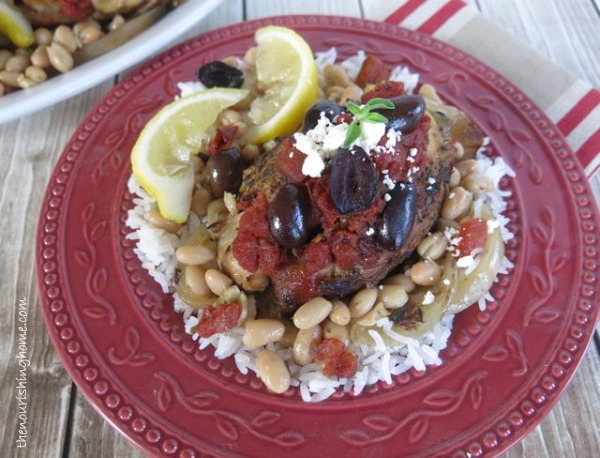
Crockpot Greek Chicken Close Up

Print
Slow Cooker Greek Chicken

5-6 servings

Ingredients

  • 1 large yellow onion, chopped
  • 3 cloves of garlic, crushed and sliced
  • 3 lbs. bone-in chicken thighs, skin removed
  • 2 tbsp lemon juice (approx. 1 lemon)
  • 15oz. fire-roasted tomatoes, diced
  • 1/2 cup pitted Kalamata olives, halved
  • 2 cups soaked & cooked white beans (*omit for Whole30, or if legume-free*)
  • Optional: Lemon slices and crumbled goat cheese for serving
  • Greek Seasoning Mix
  • 1 tsp dried oregano
  • 1/2 tsp each of onion powder, garlic powder, parsley, thyme and sea salt
  • 1/4 tsp freshly ground black pepper
  • Pinch of nutmeg

Instructions

  1. Lightly coat the bottom of a 6-quart slow cooker with olive oil or coconut oil.
  2. In a small bowl, combine the Greek Seasoning Mix ingredients. Evenly distribute the seasoning mix among the chicken thighs by sprinkling both sides of each thigh with the seasoning mix.
  3. Place chopped onion and garlic in bottom of slow cooker. Then arrange the seasoned chicken thighs over the onions and drizzle the lemon juice across the top.
  4. Evenly spoon the tomatoes and olives on top of each chicken thigh.
  5. Cover and cook on high for 5-6 hours or on low for 7-8 hours.
  6. During the last 30 minutes of cooking time, carefully remove the chicken thighs (tongs work best) and place on a platter. Stir in the beans, if using – otherwise, skip this step. Then carefully add the chicken back to the crockpot and continue cooking.
  7. When ready to serve, place about a half-cup of rice or grain-free cauliflower rice on each plate, if desired. Then place the chicken thighs over the rice with a large ladle or two of the white bean mixture. Garnish with lemon wedges and crumbled goat cheese, if desired. Enjoy!

Notes

I recommend doubling or tripling the Greek seasoning mix in this recipe and keeping it on hand for creating other tasty dishes. For example, Greek seasoning makes a flavorful addition to burgers and grilled meats. Simply add it to your favorite meat and fire-up the grill for a quick and delicious dinner!

3.1
https://thenourishinghome.com/2014/01/slow-cooker-greek-chicken-white-beans-gf-df/

Disclosure: Some of the links in this post include affiliate links, providing The Nourishing Home a small percentage of the sale at no additional cost to you. Of course, you are not obligated to use these links to make a purchase, but if you do, it helps to support this site and ministry. Thank you!
You Might Also Like:

Honey Graham Cracker Cookies
Happy New Year Sale! Honeyville Blanched Almond Flour as low as $4.25 a pound!
A Real Food Journey – Small steps in the right direction!

Filed Under: Uncategorized ·

Slow-Cooker Italian Roast with Peppers in Au Jus (GF)

By Kelly · 18 Comments

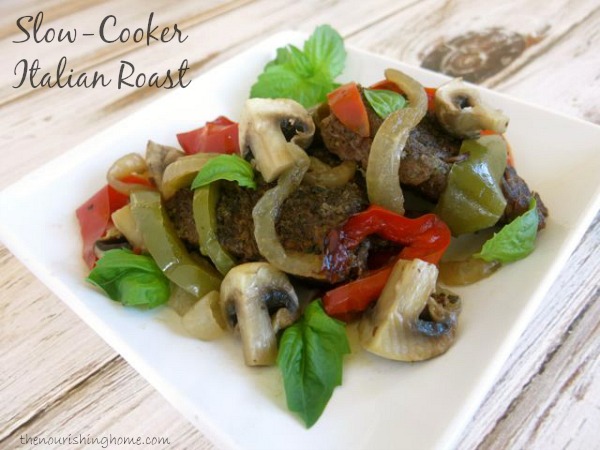
Slow Cooker Italian Roast

Real comfort food stirs up feelings of warmth. happiness. fond memories … all those heart-warming traits that make a recipe worth passing down generation after generation.

Yet, despite the fact it hasn’t been that chilly here this month, nonetheless, I can’t get wintertime comfort foods out of my mind! No bother. The lack of freezing temperatures is no reason to miss out on the simple joy of a warm meal of rich, tasty beef slow-roasted to perfection … my trusty friend Monsieur Crockpot doing all the work, while I go about a busy day of chauffeuring the boys here, there and back again.

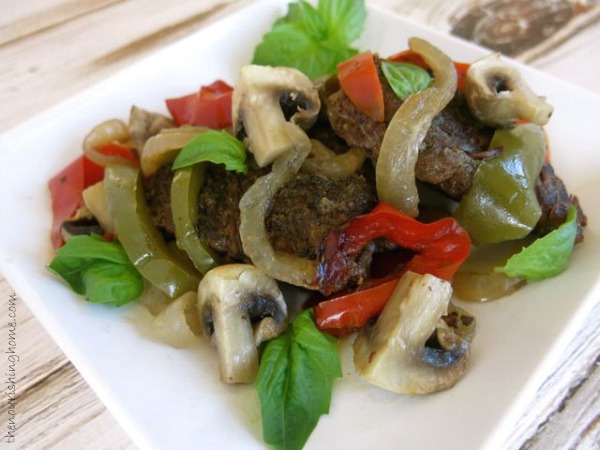
Slow-Cooker Italian Roast Peppers

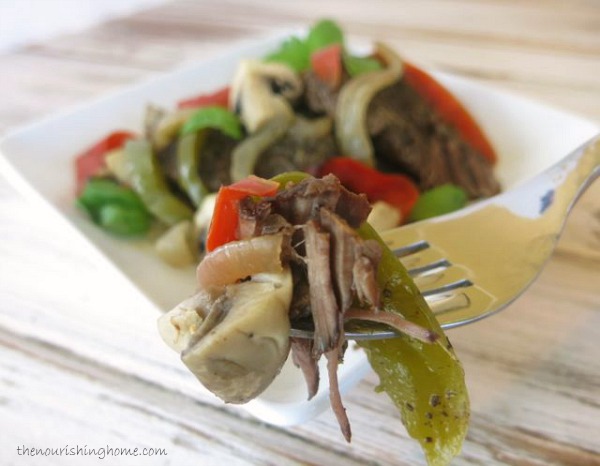
The recipe? It’s an heirloom. True comfort food at its finest. So moist and delicious, it’s hard to believe this slow-cooker Italian roast is so simple to make. Just toss the ingredients into your crockpot and go … a delightful dinner will be waiting for you when you get home.

Slow-Cooker Italian Roast wPeppers

Print
Slow-Cooker Italian Roast with Peppers in Au Jus (GF)

Yield: 4 servings

Ingredients

  • 1 1/2 lbs boneless beef chuck roast, cut into 4 equal pieces
  • 1 1/4 tsp dried Italian seasoning
  • 1/2 tsp sea salt
  • 1/4 tsp fresh ground black pepper
  • 1 medium green bell pepper, seeds removed, sliced
  • 1 medium red bell pepper, seeds removed, sliced
  • 1 medium sweet onion, sliced
  • 10 oz. white mushrooms, quartered
  • Au Jus Ingredients
  • 1/3 cup beef or chicken stock (homemade stock is best!)
  • 2 tbsp red wine vinegar
  • 1 tbsp Worcestershire sauce
  • 1 tbsp pure maple syrup

Instructions

  1. Lightly coat bottom of a 6-quart slow cooker with olive or coconut oil.
  2. Season both sides of each piece of roast with Italian seasoning, salt and pepper. Place meat in the bottom of the slow cooker and top with the peppers, onion and mushrooms.
  3. In a small bowl, whisk together the broth, vinegar, Worcestershire sauce and maple syrup. Pour marinade over the peppers, onion and mushrooms.
  4. Cover and cook on high for 5-6 hours or on low for 7-8 hours.
  5. Divide the roast pieces among four plates and top with peppers, onion and mushrooms and a spoonful of the au jus. Garnish with fresh basil, if desired.
  6. Serve with a baked sweet potato and mixed greens salad. Enjoy!
3.1
https://thenourishinghome.com/2014/01/slow-cooker-italian-roast/

Disclosure: Some of the links in this post include affiliate links, providing The Nourishing Home a small percentage of the sale at no additional cost to you. Of course, you are not obligated to use these links to make a purchase, but if you do, it helps to support this site and ministry. Thank you!
You Might Also Like:

Easy Crockpot Beef Stew (GF, DF)
Grilled Skirt Steak with Balsamic Marinade (GF)
Hearty Turkey-Veggie Crockpot Chili (GF, DF Option)

Filed Under: Beef/Pork, Slow Cooker ·

How Much is Your Time Worth?

By Kelly · 22 Comments

It’s a new year – and a new opportunity to get that food budget back on track! To help us, my friend Tiffany from Don’t Waste the Crumbs will be sharing a few frugal budgeting ideas with us each month. Take it away, Tiffany …

How Much is Your Time Worth
One of the first lessons I learned early on in my real food journey was that making food from scratch can save a lot of money.

Our grocery budget in The Crumbs Household is $330/month for two adults and two children (ages 6 and 4), so I immediately employed every make-it-from-scratch technique I could possibly find to keep us from overspending.

I started making yogurt, beans and bread.  Then salsa, protein bars and tortillas.  Recently pie crusts, almond milk and even sweetened condensed milk.

And while we were definitely saving money making some things from scratch, there was another lesson to be learned:  Making food from scratch can take a lot of time.

Time is always in short supply and high demand. In fact, it took me a long time to learn the hard way that my time is NOT always best spent making every single food we eat from scratch. 

There are instances where it’s more cost- and time-efficient to buy healthy real food ready-made from the market. Yet on the other hand, there are other instances where it’s just as easy to make the same food at home, possibly for less.

In either case, it’s important for every family to find their own unique balance between time and money when it comes to real food. Not just so you can save money, but so you can save your sanity too! After all, being in the kitchen 24-7 isn’t healthy for you or your family who loves you.

Let me share an example with you … Kelly and I were talking on the phone last week about this whole concept of time vs. savings, and she shared with me that many times she doesn’t make regular tomato salsa from scratch.  If she needs just a cup or so for one meal, it just doesn’t make sense for her (money- or time-wise) to buy all of the ingredients and make a big batch from scratch, only to use a small portion as a condiment for one meal. Instead, in this case, she buys only as much salsa as she needs from her local market and makes sure only whole foods are listed in the ingredients.

On the other hand, I always make salsa from scratch.  My taco-loving family consumes salsa like it’s water, so a single 32oz batch is gone in just a few days.  I know first hand that for my family, it doesn’t make sense for me to buy it.

Homemade Salsa

Here’s another time vs. savings example.  For the first half of 2103, you could always count on me buying two whole organic chickens and cutting them into chicken pieces myself.  Doing this provided enough chicken for eight meals plus stock for four soup nights – that’s 12 nights of meals every month for a total of $18.

Then one day while strolling through Costco, I found pre-packaged, organic chicken drumsticks that cost less per pound than what I was paying for the whole chickens!  I thought I had hit the mother load.  Not only could I save money, but I could save time by not having to chop up whole chickens (and cleaning up my mess afterward)!

Each Costco package had three individually wrapped sections and each section contained five drumsticks.  One package yielded enough meat for three meals plus stock for two soup nights – that’s five nights of meals for only $11.

But do you see where my logic went wrong?

I thought the drumsticks were a better deal because they cost less per pound and didn’t require any of my time to prepare.  But I was wrong.

I would have to buy two of the pre-packaged drumsticks, plus another two pounds of meat, to end up with the same amount of meat if I had simply bought two whole chickens.  In terms of money, it would cost another $9.

From start to finish, it takes me 15 minutes to rinse, peel off the skin and carve a whole chicken into parts.  If I’m doing two chickens at once, it’s a total of 20 minutes.

Are those 20 minutes worth $9?  For me, the answer is Yes!

So here’s my proposal to you:  As you evolve in your real food journey, consider how much your time is worth, and spend both wisely.

How Do You Do This?

1.  Consider What You Eat Often

One of the great advantages of making food from scratch is that you can ensure that only healthy real food ingredients are used, thereby greatly increasing your nutritional intake. So when considering what to make from scratch, it’s important to think about the types of food you eat most often and start with investing the bulk of your time in making these foods, if it makes sense to do so.

It comes down to figuring out not only what made-from-scratch foods will save you the most money, but which ones will also have a higher likelihood of increasing your nutritional intake. Then it’s a matter of balancing your time, since for most of us it’s simply not possible to make everything from scratch.

For example, you’ll hear often among real foodies that making your own cultured foods like yogurt saves a lot of money.  And it absolutely does!  That is, if you eat a lot of it. However, if your family only eats a cup of yogurt each week, it simply doesn’t make sense for you to spend the time, money or energy in buying a starter culture, milk and then culturing your own.  Just buy the single cup, make sure it’s full fat without added sweeteners or fillers.

Beans are another great example.  They’re a nutrition powerhouse and average only 30¢ when you make them from scratch compared to $1 or more per can.  Saving 70¢ on each can of beans can really add up over time, but only if your family eats them!

It’s important to mention that sometimes it can cost more to make a food from scratch, but if the nutritional benefits far outweigh the cost involved, it may be worth the investment of extra time and money. But again, only you can decide the right balance between nutritional advantages, time saving and money savings.

2.  Consider What You Don’t Eat Often

For foods you eat infrequently, it simply may not make sense to spend time creating these foods from scratch, particularly if healthy whole food options are readily available.

As a personal example … breadcrumbs are REALLY easy to make from scratch, but I don’t make them anymore because of one valid point:  My family doesn’t eat them.  So regardless of how simple they are to make, it’s still too much time, effort and energy to make my own.  Instead, if I happen to need them, I simply buy a container (without any artificial ingredients) and call it done.

3.  Start Small

There’s no greater deterrent than trying to do too much at one time.  Choose one item that you eat often and try to make it from scratch.  Pull out the calculator and see if you saved anything by making it at home versus buying it at the store:

  • pre-cut and packaged fruit or veggies vs. buying whole fruits & vegetables and slicing them yourself
  • pre-washed bagged lettuce vs. whole heads and washing, cutting at home
  • homemade bread vs. packaged or fresh bakery breads
  • homemade snacks such as crackers and energy bars vs. less healthy packaged versions
  • homemade condiments such as salad dressings and mayo vs. less healthy packaged versions
  • homemade cultured foods such as yogurt, kefir, buttermilk, lactoferments, etc vs more expensive store bought versions
  • soaking and cooking your own beans vs. more expensive canned versions

Again, consider the nutritional benefits, financial savings and the time required to make the foods you eat from scratch and decide for yourself if it’s worth it.  Sometimes it is.  Sometimes it isn’t.  Every situation and family is different, so you’ll have to ask yourself – How much is your time worth?  And do what’s best for YOUR family!

We’d love to hear your thoughts … What are real foods do you invest your time in making from scratch? And which do you opt to purchase already made instead?

You Might Also Like:

8 Strategies for Saving Money at Farmers Markets
Real Food on a Budget, Part 2
Real Food Guide to Gluten-free Food at Costco

Filed Under: Real Food on a Budget ·

  • « Previous Page
  • 1
  • …
  • 59
  • 60
  • 61
  • 62
  • 63
  • …
  • 182
  • Next Page »

My New Cookbook is Here!

Welcome to The Nourishing Home!

I’m so glad you’re here and want you to feel right at home! My heart in creating this blog is to help you by sharing helpful meal planning strategies and nourishing GF recipes that are healthy, easy and delicious with thanksgiving to God! [Read More …]


All content (recipes, photos, posts, etc.) on this site is the creative property of Kelly Smith. You are welcome to share a photo via social media, as long as it contains a link back to the corresponding recipe or post from this site. However, you may not republish a recipe in its entirety in any form. For questions, or for permission to use a photo or recipe, please contact me via email at [email protected]. Thank you!

Please Note: All content (recipes, photos, text, etc.) on this site is the creative property of Kelly Smith of The Nourishing Home. You are welcome to share a photo via social media, as long as it contains a link back to the corresponding recipe from this site. However, re-publishing a recipe in any form is strictly prohibited. Additionally, please refrain from adapting recipes without properly linking back to the original recipe, and keep in mind that simple substitutions do not constitute an adapted or original recipe. For details regarding recipe copyright law, please visit the Food Blog Alliance.
The Nourishing Home is a participant in the Amazon Services LLC Associates Program, an affiliate advertising program designed to provide a means for sites to earn advertising fees by advertising and linking to amazon.com.

Privacy Policy
DMCA.com

Copyright © 2026 · All Rights Reserved · The Nourishing Home · Artwork by Nancy Panaccione · Site Design by Deluxe Designs · Log in