The Nourishing Home

living healthier lives in service to the King!

  • Home
  • About
    • About TNH
    • Contact
  • Meal Planning
  • Health & Wellness
    • Real Food Basics
  • Whole30
  • GF Recipes
    • Whole30
    • Breakfast
    • Lunch
    • Entrées
    • Slow Cooker
    • Soups & Stews
    • Sides & Salads
    • Snacks
    • Desserts
    • Kids in the Kitchen
  • My Cookbook
  • Subscribe

Tips for Transitioning to a GF Lifestyle

By Kelly · 2 Comments

Tips for Transitioning to a GF Lifestyle

Many individuals and families are considering whether or not to go gluten free? For some, the decision is the result of a serious gluten-related illness, such as celiac disease, Crohn’s disease, inflammatory bowel disease, etc. For others, it’s yet another attempt to uncover the reasons for unusual, unexplained symptoms that seem to persist despite healthy lifestyle changes.

Whatever the reason you’ve decided (or may be considering) to make the transition to a gluten-free lifestyle, the tips below are provided to help and support you in your newfound journey – from someone who knows just how overwhelming the prospect of eliminating gluten (and grains) can be.

So as you start down the GF path with the hope of transforming your health, let me encourage you that every journey starts with small steps forward, and it’s those slow, steady steps that lead to positive changes that last a lifetime!

Tips for Successfully Transitioning to a GF Lifestyle:

1. Do your homework – If you don’t have a few specific reasons and goals for going GF, then it will be much harder to maintain this restrictive lifestyle for the long-haul. So take time to do your own research on the GF diet, seek the advice of a trusted healthcare practitioner and set some goals to track and measure your progress.

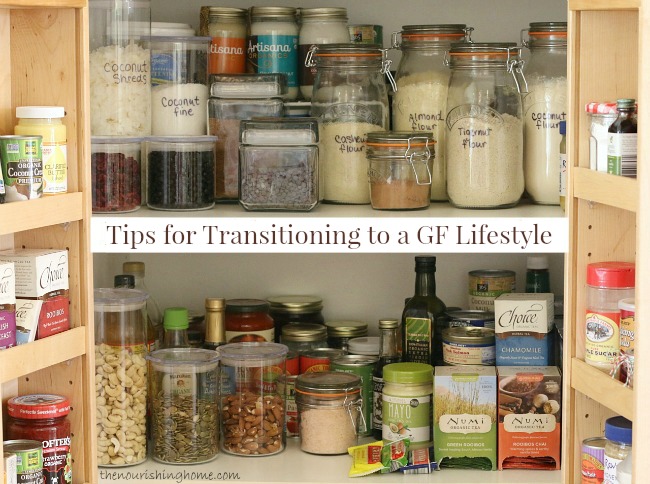
2. GF Kitchen Makeover – It’s not always do-able to completely rid your kitchen of all gluten (and grains, if you’re grain-free), if your family is not going GF too. So do what is best for you and your family. Since I’m the only one in my home that’s GF, I’ve dedicated one shelf in the pantry and fridge for my family to keep their gluten-laced stash. Of course, the more you can rid your home of gluten the better for the sake of keeping temptations at bay and reducing the risk of cross-contamination.

3. Stock up on GF foods you already love ­– Fresh veggies, fruits, nuts, seeds, beans, meat, fish, poultry and eggs are not only naturally gluten-free, they are REAL whole foods chock-full of great nutrition. So focus on stocking up on these foods! In addition, be sure to also have plenty of healthy fats on hand, such as butter, coconut oil, olive oil, seeds, and nuts. By focusing on whole, unprocessed naturally gluten-free foods, you’ll jumpstart the process for healing your gut and increasing your health and energy levels.

4. Put your apron on – The more you cook at home, the healthier you’ll eat, the more money you’ll save and the less likely your chances for being “glutened” – an infamous expression that describes the horrible discovery that you’ve become ill because you’ve inadvertently ingested some hidden gluten. Ugh! Yet, it’s important not to become a hermit either, so see “Be Prepared” below for tips on how to venture out safely.

5. Embrace meal planning – No matter what diet you follow, there is nothing more helpful than meal planning! That’s because it helps to save time, money and stress in the kitchen. And it’s the key to helping individuals stay on track with their healthy eating goals. You will not only find lots of great meal planning resources here, but I also provide free monthly meal plans over at The Better Mom blog. Each week’s meal plan contains delicious family-friendly GF recipes utilizing a time-saving method to make getting a healthy dinner on the table a snap! I highly recommend you pop over to The Better Mom and download these free meal plans.

6. Get inspired – There are so many delicious GF recipes out there, all you need is a little bit of inspiration and you’ll be amazed at how quickly you will learn and expand your GF culinary horizons. You can always find inspiration via the recipes here at The Nourishing Home, as well as at other helpful GF blogs.

7. Be prepared – When it comes to eating away from home, the boy scouts have it right – “Always be prepared!” Just a few simple ways to do this are to keep snacks on hand, so no matter what the situation, you have a quick, healthy snack. If you’re attending a dinner party, church fellowship or other food-related event, you may want to eat beforehand just incase there’s nothing there that you can safely eat. Or in the case of dinner at a friend’s or family member’s home, ask if you can bring a dish or simply explain your dietary restrictions. Thankfully, most people are very happy to help accommodate. And when it comes to restaurants, it’s better to put a little time into researching a few trusted restaurants in advance, than to arrive only to find there aren’t many (or any) viable options.

8. Read Labels – Unless you are planning to make every single food you eat from scratch, one of the most important things you can do, as someone who must avoid gluten, is to get savvy with reading food labels. It may seem overwhelming at first, but there are so many hidden sources of gluten out there, it’s vital to know how to identify gluten-based ingredients.

9. Give Yourself Grace – It takes time to learn a whole new dietary lifestyle, you’re going to make mistakes and have a few hiccups along the journey. That’s normal and to be expected. The key is to not give up, but instead stay focused on your goals and keep making forward progress.

10. Get Support – It’s not easy to be gluten-free, especially if you’re flying solo. So getting connected with other gluten-free friends in your community or online can really be a source of encouragement. Having others to share questions and learn from is so helpful in staying motivated and inspired. Many of the major GF organizations have listings for local support networks, and offer online support forums.

And the best tip of all is to of course, seek the Lord and trust in Him. God promises that when we seek Him first, He will take care of us. He may not always take away the thorn in our flesh, but He is faithful to give us His grace and strength daily to live for His glory and the furtherance of His Kingdom! (Matthew 6:33)

Joyfully Serving HIM, Kelly
You Might Also Like:

Test Kitchen Showdown: Which Lunch Box Food Storage System is Right for Your Family?
Favorite Homemade Holiday Gifts-in-a-Jar Ideas
The Nourished Kitchen – A Masterpiece Collection of Farm-to-Table Traditional Food Recipes

Filed Under: Resources, What is Real Food ·

Should Everyone Go Gluten-Free or Grain-Free?

By Kelly · 32 Comments

Should Everyone Go Gluten-Free

Yes, I am gluten-free (and 99% grain-free) and I’ll be sharing more about my personal health journey with you soon, dear friends. But first, I wanted to take a moment to pose a common question that many are asking (or silently mulling over in their minds).

It’s a question that I don’t take lightly, because it’s one that I myself took a lot of time to consider. If there is one thing about me that you should know, it’s that I’m a painstakingly slow decision maker. And if everyone’s jumping on a bandwagon, it often gives me even more reason to pause and consider what’s the right choice for me?

Probably because I’m not a fan of fads ­­– especially fad diets. They come, they go, and the majority of the time they leave their followers frustrated, overwhelmed and malnourished.

Instead, I’m a firm believer in adopting a healthy lifestyle – a consistent lifelong pattern of healthy living that comes from a taking a personalized, holistic approach to one’s health.

I share this because taking a personalized approach to achieving a healthy lifestyle is what I believe to be the key to answering the REAL question:

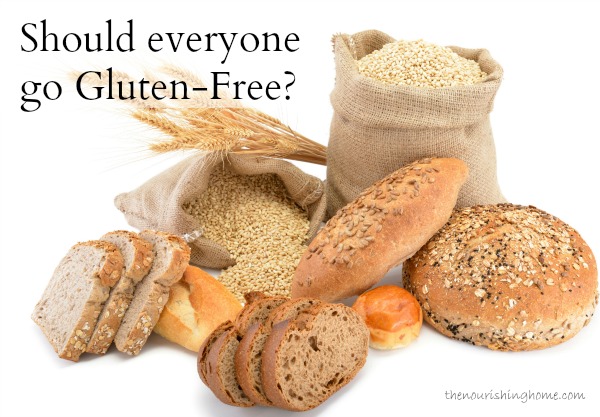
Should Everyone I Go Gluten-Free or Grain-Free?

When the answer might be YES!

For some (like me), being gluten-free (or grain-free) isn’t a matter of wanting to embrace the so-called latest dietary trend – it’s a legitimate necessity!

For example, living gluten-free is an absolute must for those with Celiac Disease, since even the smallest amount of gluten triggers a serious immune system response that damages the lining of the small intestine, resulting in a number of debilitating symptoms and problems related to malnutrition.

Yet, it’s important to note that troublesome reactions and health issues related to gluten intolerance are more prevalent than previously realized. According to recent research, experts now agree that celiac disease represents just one extreme of a broad spectrum of gluten intolerance that includes millions of people with problematic reactions to the protein.

So, while celiac disease affects about one percent of the U.S. population, experts now estimate that as many as 10 percent of the population may have a related condition known as Non-Celiac Gluten Sensitivity (NCGS), often referred to as gluten sensitivity.

The problem is, many physicians are unaware of NCGS, and the common tests used to detect Celiac Disease do not reveal the whole story when it comes to gluten sensitivity. For more about NCGS, be sure to read this article by Chris Kresser, “Gluten Intolerance May Be More Serious Than Celiac Disease.”

For individuals with NCGS, going gluten-free is also a necessity in order to help alleviate troublesome symptoms and chronic health issues, particularly autoimmune related disorders, inflammatory bowel disease, autism, ADD/ADHD, asthma and more.

It’s also important to note that for many, gluten intolerance may not present with typical digestive-related symptoms. In fact, nearly 50 percent of individuals diagnosed with NCGI do not have gastrointestinal symptoms at all, which is why there are so many undiagnosed cases of gluten intolerance.

So I would hope that this proves the point that the GF lifestyle is no fad diet, but is instead a required lifestyle for countless individuals in order to achieve improved health and wellness. Therefore, just because the GF diet is receiving a lot of limelight right now, doesn’t make it a fad. What makes anything a fad, is when individuals jump on board with no real thought as to why they are doing it …

When the answer might be NO.

But what about those who do not have a specific health issue that’s best addressed by removing gluten (and potentially grains as well)? Should these individuals go gluten-free or grain-free too?

Some might disagree, but my two cents (i.e. opinion*) is it’s best to first stop and think before taking the plunge. Living a GF lifestyle requires commitment. It’s a very restrictive diet, so special measures must be taken to ensure proper nutritional balance. That’s why I recommend doing your own research before going gluten-free,  grain-free (or anything-free), particularly if your motivation is simply because everyone else is doing it. In fact, I can’t help but recite the sage words of moms everywhere – “Just because everyone else is doing it, does that mean it’s right for you?”

So take some time to read up on the GF diet, be sure to talk it over with a trusted health care practitioner, and ask yourself some important questions:
• How would the GF lifestyle benefit me personally?
• What is my motivation for wanting to go GF?
• Am I committed to making this a lifestyle? (Or at least committed to an extended trial period to evaluate its potential benefits?)
• What support and resources will I need to make this a healthy transition?

The fact is, despite the wonderful benefits of the GF lifestyle for many of us with chronic health issues and gluten sensitivities, it doesn’t necessarily mean it’s the one and only ideal diet for everyone period. After all, God created grains for man’s nourishment (as recorded in His Word) and mankind has been enjoying and thriving upon properly prepared whole grains since the beginning of recorded history.

So although I am a firm supporter of the GF lifestyle which is why you will find The Nourishing Home to be a wonderful resource for nourishing whole food GF recipes and meal plans, you will never find me preaching it’s the one and only lifestyle for every single person period.

Instead, just as the Lord has walked me down this pathway of grace and mercy in helping me to better achieve health for the sake of better serving Him and those he’s placed in my life – my prayer is that He will guide and direct your steps as you walk with Him in your own personal journey toward living a more nourished life.

Seeking the True Bread Life!

So let’s make healthy living, whichever path we decide to take, about embracing a whole hearted lifestyle – an intentional journey toward making small steps forward in nourishing our bodies and souls, so we can better serve the Lord.

Because no matter which diet we choose, there is no greater nourishment that we can receive than to put our faith and hope in the Lord Jesus Christ and to follow hard after Him … “I am the bread of life; whoever comes to Me shall not hunger, and whoever believes in Me shall never thirst … For this is the will of my Father, that everyone who looks to the Son and believes in Him should have eternal life, and I will raise him up on the last day.” (John 6)

*Please note: I am not a medical professional, and I strongly believe that it’s vitally important for individuals to make their own healthcare and dietary decisions based upon their own personal research and in partnership with a qualified health care professional. 

You Might Also Like:

The Nourished Kitchen – A Masterpiece Collection of Farm-to-Table Traditional Food Recipes
Hitting the Pause Button! 5 Strategies for Reducing Stress and Learning to Rest
Feeling SAD? It may be the Wintertime Blues.

Filed Under: Resources, What is Real Food ·

5 Frugal Ways to Save on Groceries without Using a Calculator

By Kelly · 23 Comments

5 Frugal Tips to Save on Groceries

NOTE FROM KELLY: Happy news! … My dear friend Tiffany at Don’t Waste the Crumbs is joining The Nourishing Home as an official monthly contributor. Each month, she’ll be sharing some of her favorite frugal tips for Real Food on a Budget. Many of you already know Tiffany via her terrific blog and the many guest posts she’s shared here, such as my personal favorite “Small Steps in the Right Direction.” It’s a joy to have her join me in this ministry to help you and your family live a more nourished life in service to the King. Welcome aboard, Tiffany!

As 2013 draws to a close, many of us are considering how we can “do better” in 2014.  This short series on creating a frugal grocery budget inspired quite a few families to hunker down and reign in their food expenses for the New Year. But, if the idea of crunching numbers makes you cringe, here are five super simple, frugal ways to save on groceries – any time of year – without using a calculator.

  1. Save butter wrappers for greasing pans.  Grass-fed butter is full of health benefits like weight management and gastrointestinal health, but it also costs a pretty penny.  So instead of throwing away the wrappers, we save them for greasing baking sheets and cooking pans.  It allows us to stretch one can of cooking spray to last nearly six months!
  2. Count bananas sold in bunches.  Bananas are one of the most frugal fruits available year round, and are often sold in bagged bunches.  The typical bunch includes seven bananas.  In some cases, you can find a bag with eight or even nine bananas.  Intentionally seek out a bag with ten bananas and you’ve essentially gotten three bananas for free!
  3. Weigh fixed-price, pre-bagged produce.  Produce is usually sold in one of two ways: Either you bag it and pay per pound, or it’s pre-bagged and you pay a fixed price for the bag.  If you weigh the pre-bagged produce, you’ll often find it’s heavier than the 3lb or 5lbs stated.  Choose three to five “heavy” bags and weigh each, purchasing the heaviest bag out of the bunch.  You can end up with up to two pounds of additional produce for the same price!
  4. Save overripe produce (and scraps) for smoothies.  Got overripe produce? Don’t toss it. Chop and freeze it for use in smoothies. Likewise, when you’re chopping fresh fruits and vegetables for snacks and meals, don’t toss the scraps – save them to make smoothies!  Strawberry tops, apple cores (minus the seeds), the ends of carrots, etc. all make excellent additions to smoothies. By saving overripe produce and scraps, you’ll reduce your waste, stretch your food AND enjoy the health benefits of real food smoothies.
  5. Eat like you’re going on vacation.  No one likes to come home to moldy leftovers, or expired food, after being out of town. So we make a practice of pretending we’re about to go on vacation to ensure we’re making use of all the food we’ve purchased to eliminate any wasted, expired food. If you incorporate “pre-vacation eating” into your meal plan (planning meals around what you have left in your fridge and pantry), you’ll most certainly rack up the savings in your grocery budget. Plus, you just might devise a few new recipes in the process!

Can these 5 simple tips really save you money?

Absolutely!

I know I told you that you wouldn’t need a calculator, and you don’t! I’ve done the math for you just to demonstrate how little tips like these can really add up to big savings …

  1. A can of olive oil cooking spray is approximately $1.99.  If you buy one can every two months (on average), you would save $8 a year by using butter wrappers instead to grease your pans.
  2. In my area, Costco sells bananas for $1.39 per bag.  By seeking out bags with ten bananas, you can save 60¢ each week.  This doesn’t sound like much, but over the course of a year that equates to saving more than $31 on just bananas!
  3. $1 per pound for fresh seasonal produce is a pretty common price.  By weighing pre-bagged produce and choosing the heaviest bag, you can save anywhere from $1 to $2 each time.  Over the course of a year, that’s nearly a $104 savings on produce!
  4. We spend good money on food, so throwing food away is really a waste of money.  By turning food scraps into smoothies you’re creating extra meals without spending extra money.  So if you blend a high protein smoothie using your produce scraps, instead of buying a smoothie from a local shop, you could save $4 with each smoothie you make at home, or $208 in savings per year! (Note from Kelly: Tiffany is being a little humble here in not tooting her own horn loud and proud … so I’ll let you in on the good news – she has a completely awesome new eBook launching in January full of terrific real food high protein smoothie and bar recipes. I’ll be posting a review on her book and sharing one of her delicious recipes next week! So stay tuned.)
  5. In the Crumbs household, our grocery budget is $330 per month, or $82 each week.  By making it a habit of eating like we’re about to go on vacation every so often, we saved nearly $250 in one year!

Total savings for these five simple tips?  $601!

Looking for more ways to save money in 2014?  Subscribe to Don’t Waste The Crumbs weekly newsletter.  It’s free, filled with exclusive content not found elsewhere on my site and it always includes tips to help you eat real food, on a real budget!

And while you’re at it, be sure to sign-up for Kelly’s new weekly The Nourishing Home newsletter, which launches in January 2014. She’s got some great budget-saving tips and other real food resources and recipes in store for you in the New Year as well!

What is your favorite frugal tip for saving on your family’s food budget? Please share below!

You Might Also Like:

The Secret to a Healthy Grocery Budget: Keeping Your Receipts
How Much Food is Enough?
Top 10 Grocery Budgeting Tips of 2014

Filed Under: Real Food on a Budget ·

  • « Previous Page
  • 1
  • 2
  • 3
  • 4
  • 5
  • 6
  • 7
  • Next Page »

My New Cookbook is Here!

Welcome to The Nourishing Home!

I’m so glad you’re here and want you to feel right at home! My heart in creating this blog is to help you by sharing helpful meal planning strategies and nourishing GF recipes that are healthy, easy and delicious with thanksgiving to God! [Read More …]


All content (recipes, photos, posts, etc.) on this site is the creative property of Kelly Smith. You are welcome to share a photo via social media, as long as it contains a link back to the corresponding recipe or post from this site. However, you may not republish a recipe in its entirety in any form. For questions, or for permission to use a photo or recipe, please contact me via email at [email protected]. Thank you!

Please Note: All content (recipes, photos, text, etc.) on this site is the creative property of Kelly Smith of The Nourishing Home. You are welcome to share a photo via social media, as long as it contains a link back to the corresponding recipe from this site. However, re-publishing a recipe in any form is strictly prohibited. Additionally, please refrain from adapting recipes without properly linking back to the original recipe, and keep in mind that simple substitutions do not constitute an adapted or original recipe. For details regarding recipe copyright law, please visit the Food Blog Alliance.
The Nourishing Home is a participant in the Amazon Services LLC Associates Program, an affiliate advertising program designed to provide a means for sites to earn advertising fees by advertising and linking to amazon.com.

Privacy Policy
DMCA.com

Copyright © 2026 · All Rights Reserved · The Nourishing Home · Artwork by Nancy Panaccione · Site Design by Deluxe Designs · Log in