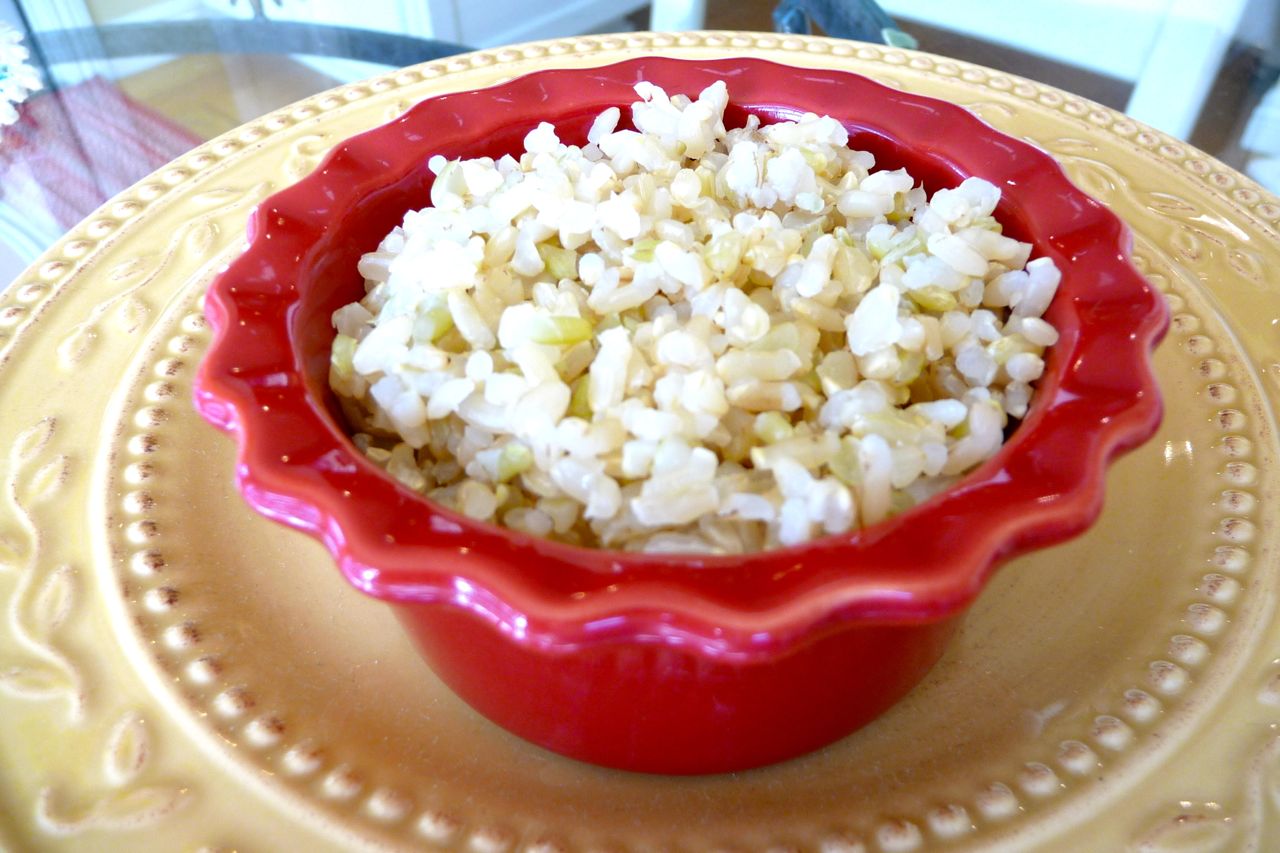
If you’re new to soaking grains, this is a great recipe to start with since it’s so easy to prepare and works well with just about any favorite rice-based recipe.
Soaking is a centuries-old method that helps to breakdown the antinutrients and hard-to-digest components of grains, and at the same time, helps to release highly beneficial nutrients. For more about the whys and hows of soaking, please check out “How to Soak Grains for Optimal Nutrition.”
Soaking brown rice and other grains is really very easy! It just takes a little planning ahead. The result is a highly nutritious and easy-to-digest whole-grain food with wonderful robust flavor.
Time-saving Tip: Triple this recipe and refrigerate the leftovers for multiple dishes throughout the week. Below are several of my family’s favorite recipes using soaked brown rice:
• Soaked Brown Rice Breakfast Porridge
• Buttery-Herbed Brown Rice
• Orange Chicken Stir Fry with Broccoli
Ingredients
- 1 cup of organic brown rice (I prefer short grain style)
- 1-2 tsp raw apple cider vinegar (or lemon juice)
- 2 cups warm filtered water
- 1/8 teaspoon of Celtic sea salt
Instructions
- Add above ingredients to a medium ceramic (or glass) mixing bowl and thoroughly combine.
- Cover the bowl and place it in a warm area of your kitchen overnight (8-12 hours).
- After soaking time is completed, drain mixture using a fine-mesh strainer and gently rinse.
- Place drained rice in medium saucepan and add approximately 1 3/4 cups water (or *bone broth). Bring to a boil. Then, immediately cover and reduce heat until you achieve a gentle simmer.
- Cook approximately 25-40 minutes until rice has absorbed the liquid and reached the consistency you desire.
Notes
*Cooking rice in bone broth helps to further mitigate the effects of phytic acid and bone broth in general offers tremendous health benefits. For more information, check out "The Amazing Health Benefits of Bone Broth."

Hi! Thank you so much for this wonderful blog!! Can I cook rice in rice cooker once the rice has been soaked or do I need to cook on stove top? Thanks, Sue
Yes, you sure can use your rice cooker. You may need to adjust the liquid and cook time a bit since the rice does absorb a little water during the soaking process. Blessings to you, Kelly 🙂
Thanks!!!
My pleasure! 🙂
Tryed this today. This was the best brown rice I ever made. Soaking made a huge difference. Much lighter in texture.
That’s great, Stacey! So glad you enjoyed this recipe. Appreciate you taking the time to leave a kind note! 🙂 Blessings, Kelly
Is it safe for children under 3yrs to eat brown rice?
If your child does not have any allergies or health issues, it should be fine to include soaked grains (such as soaked brown rice) into his/her diet. If you are uncertain due to family allergy issues, it’s best to seek the advice of a naturopath or trained nutritional therapist who can review your family and child’s health history and do an evaluation or tests to determine foods that should be avoided. Blessings, Kelly 🙂
I’d wait till they were 18 just to be sure.
My daughter has not shown any allergy signs and she’s been havin it since she was 6 months. She eats what everybody else eats. I would just go with your instinct. I just thought it was an way way to give the kiddos bone broth!
I got my rice soaking right now! I really like your blog. Thanks for all that you do. Your blog is so informative and spirit-filled! 🙂
aww, thanks, Becca! What blesses my heart more than anything is when someone can see my heart for the Lord here. Thank you so much! I appreciate you taking the time to leave a kind note of encouragement! Blessings, Kelly 🙂
Hi,
Thank you for the wonderful recipes! I’m trying this one for the first time & have a quick question. I just took the rice out from soaking & noticed an interesting smell…is it supposed to smell soured or something like that? I just rinsed the rice really well but still notice a sour/spoiled smell. Is this normal? I used lemon juice rather than the vinegar (don’t know if that matters or not). Thanks again.
Yes, the rice will have a slight soured smell (similar to the smell of buttermilk or sourdough starter) but it shouldn’t smell like rotten or spoiled food. “The nose, knows.” So if it smells rotten, rather than like a cultured product, it may have an issue. Do note however, that it’s really rare for any kind of issue to occur with soaking rice overnight, especially if you’re using vinegar or lemon juice. But still … If it truly smells spoiled, rather than simply soured, I’d err on the side of caution and toss it and try again. Blessings, Kelly 🙂
If I have sprouted brown rice should I still go through the soaking process before cooking it?
I have tried many of your recipes and they have come out great! A lot of times when I find a recipe I like and I follow it the end result comes out bland. I’m always saying the food needs more flavor, but not your recipes. Your site is my go to for recipes. Thank you for such great recipes!!
Hi, Ana! Thank you so much for your kind comments. I am so happy you’re enjoying this site! Regarding rice soaking – no need to soak sprouted rice – that’s the benefit of using it and sprouted flours – the process of sprouting is one way in which reduction of phytic acid takes place. Lots of blessings to you, Kelly 🙂
I soaked my rice for a little more than 24 hours in hot water and vinegar. It smelled sour and was bubbly at the top. I rinsed and it still smelled like that, so I threw it out. I don’t really know the difference in smell between cultured food and rotten food, so the previous answer didn’t really help me. Can someone clarify if the result I got is normal, and maybe provide a comparable smell that is ok for the rice to smell like after soaking? Thanks.
I would compare the smell of cultured food to that of buttermilk. It smells cultured, not spoiled. There is a big difference between the smell of spoiled milk and the smell of buttermilk. Perhaps this will help better explain. Also, if you are sensitive to the smell, simply soak the rice overnight, rather than 24 hours, since the longer you soak, the more the food cultures. A simple overnight soak is sufficient to help break down the phytates and it will not result in as strong of a cultured smell/flavor. And last but not least, your soaking water should be warm, not hot. It should be just slightly above body temp. I hope this helps better clarify. Lots of blessings, Kelly 🙂
Thank you Kelly!! I am slowly moving towards a macrobiotic diet, of which brown rice plays a huge role. Reading about phytic acid scared me a little, since I will be eating a lot of grains. I appreciate your help. I feel more assured 🙂
My pleasure to help! I corrected the typo for you 🙂 Blessings, Kelly 🙂
I tried soaking brown rice for the first time yesterday, and unfortunately missed a few steps and spent the evening vomiting. Wish I had read your website first!
First of all, I didn’t add any salt or vinegar to the water. So now I can fix that problem. Second, I am wondering about covering the bowl– I had it soaking in the sealed rice cooker — when you say cover the bowl, do you just mean lightly covered? Do any gases need to escape? Third question– I think my “warm place” was TOO warm. I soaked it on the countertop at home during a summer day at work and the room temperature probably got up to 90 degrees. (I also started with cold water.) Is their a max room temp at which this soaking should be done? Or was the problem mostly all caused by the omission of vinegar?
Thanks for any insight!
Christina
Hi, Christina. Sorry to hear you became ill. It sounds like you weren’t given proper instructions on soaking grains. Like anything in the kitchen (properly handling/cooking meats, or properly storing dairy) there is a chance of becoming ill if the right steps are not performed. Therefore, please be sure to read my post on soaking that’s referenced in this recipe, it outlines proper soaking techniques and should answer your questions. Here’s the link incase you missed it:
http://thenourishinghome.com/2012/03/how-to-soak-grains-for-optimal-nutrition/
In addition, I do highly recommend reading other resources (such as Nourishing Traditions) as I just cover soaking here on my site, and there are many other processes one can use such as sprouting and culturing/fermenting.
To answer your questions in brief … Yes, you must include an acid medium in any grain you soak in order for the soak to be safe and effective. And for the most part, you need only soak overnight – 8-12 hours – (extended soaking beyond 24 hrs, often referred to as sprouting, requires a different process to ensure safety). And you should cover your soaking bowl with a kitchen towel or a plate over the top of the bowl, not an air-tight container. And with regard to soaking at “room temp” – this ideally is a temp between 70-80 degrees F. Again, my post on soaking should help you to better understand the process.
Blessings, Kelly 🙂
I successfully soaked my rice, finally. I do prefer rinsing it well after soaking. Maybe that will help you also, Christina. I prefer to cook in fresh water, not the soaking water.
Agreed, Karen. I always recommend rinsing all grains before cooking and using fresh water (or bone broth) as well for improved texture and flavor. Thanks for sharing! 🙂 Blessings, Kelly
Wow… i should have read this before i went to work, i just soaked this with water… It looks like you actually need to soak this with water and vinegar for it not to go bad. is that correct?
Hi, Bri. It’s not really about it going bad as much as it’s about properly soaking to reduce the phytates. The acid medium (whether vinegar or lemon juice) is the catalyst the helps the phytase break down the phytates. I think the problem one of these individuals was having was mainly related to using hot water and soaking for an extended period of time without changing the soaking water. If you follow the recipe as outlined above you should not have an issue with food spoiling. This method of soaking is not unique to my site, but is a standard soaking method that is outlined in many traditional cooking books such as Nourishing Traditions – which I highly recommend to anyone who is wanting to adopt a real food diet. I hope this helps to clarify. Blessings, Kelly 🙂
Hi,
I have read so much about fermenting Brown Rice. Please anyone tell me why we have to throw away water after Fermenting Rice(Keeping 10% aside). Why cant we use the same water to cook that rice.
Good question! You most certainly can cook in the soaking water. But because it’s generally starchy due to the soaking process, it yields a pastier texture that many do not enjoy. Thus, the reason for rinsing the rice again after soaking and using fresh water to cook it. I hope this helps to better explain. Lots of blessings, Kelly 🙂
Thanks Kelly for such a quick reply 🙂
One more doubt regarding this… What are the water contents after fermenting the rice for 12-24 hours. Do we have any material or statistics which shows either the water is good / Very good / Neutral for health. One of the thought that comes to mind is as we are doing this all only for health and well being the texture should not matter. But after reading lot of material on net. No one or No society (Culture) suggests to use the same water for cooking ( This is my thought… Please correct if wrong). But in South India they soak rice in water for 12 hours and then cook and then keep it for fermentation. But as it has been told after you cook anything it can not be de-phytisized. But tradition is going on. So what is right and what is wrong ?
Also can we pour some of the beneficial bacteria from pro biotic tablet(Prescript Assist) into this ‘To be fermented rice water’ during first batch . May be only for the first time.
And again for countries like India or Africa can we consider time for fermentation less than western countries since temperature there is more.
All these question arouse in my mind only because there is one scientific study which says that the phytic acid got reduced but other minerals like zinc especially wasn’t found considerably more(Just some 1mg more and same for iron).
http://paleohacks.com/questions/94889/white-or-fermented-brown-rice-with-meal
But in another study for rice prepared in Assam in india where they first boil the rice and then keep for 12 hours in water the iron content was found much much higher.
http://www.telegraphindia.com/1110804/jsp/northeast/story_14328967.jsp
The only considerable difference between our and their method is we throw the fermented water and cook the rice in fresh water.
Also the instruction for Fermented rice water was same , to throw the first water.
Also another question if it is possible can we drink that fermented rice water instead of throwing.
Then again one of the solutions can be like. If after soaking some bad substances enter into water then can we soak the rice for 10 min in normal water then throw away that water and then put in for fermentation. May be that will be assuring.
There are lot of question. But if could get right way then we can reduce the meat as we could get it from fermentation. But there should be some statics showing how much zinc or iron remains in Rice and in the water.
Hope your guidance will be helpful for me and also for all the others who would visit this page in future. Thanks….
Looks like you’ve put a great deal of time into researching this and that is great, as I always encourage individuals to their own research and form their own conclusions based on their personal health issues and health goals. I personally have not come across any literature giving a breakdown of the exact contents found in the soaking water for rice and whether there would be any benefit in consuming soaking water. But, that’s not to say that such a study does not exist.
Just to clarify, the method described here for soaking grains follows recommendations by the Weston A Price Foundation based on research analyzed by this organization. As much as I love to research, I am most certainly not a PhD authority on the matter of soaking and fermentation, and therefore, I believe your questions as to the actual content of the soaking water and whether to use the soaking water for consumption would be well suited for someone like Rami Nagel to field. Rami has extensively reviewed the literature on soaking, including many multi-culture methods like those you’ve mentioned. You can find his white paper here: http://www.westonaprice.org/food-features/living-with-phytic-acid and he also has a FB page and takes questions there, as well as at his website, here’s specifically the page he addresses grains: http://www.curetoothdecay.com/Tooth_Decay/whole_grains_cause_tooth_decay.htm
My intention here at my site is to provide basic information on the benefits of soaking based on the book Nourishing Traditions and research provided by the WAPF. But again, I always suggest that people do their own research and come to their own conclusions based on their personal health issues and health goals. It’s VERY easy to get obsessed with trying to control every aspect of one’s diet to the point it become almost a religion for some. I don’t ever want to lead people down that pathway. I’m certainly not saying this is the case for you, but since others may read this discussion, I want to be sure I make it clear that when it comes to our health, we need to be seeking improved health for the right reasons – in order to better serve the Lord, fulfill His Will for our lives and to bring Him all glory and honor with our lives. And we need to not make the pursuit of health an idol that completely takes control of our lives.
In other words, I never want anyone to walk away from this site without knowing that the Lord is the one who can heal and preserve health. We certainly need to make wise choices and be discerning, but it’s important to make sure it’s not food we’re trusting in instead of the Lord. I think we all know man is fallible – research studies are constantly contradicting one another and so the best we can do is to stick to the real food God created for our well being and prepare it to the best of our ability without making it become a burden, a point of stress or an idol in our lives. My intention here is to provide some basic methods to eat healthy without any of these coming into play, but instead to encourage each one of the beautiful people God brings my way to fully trust in Him and to use their lives to bring Him glory and to better live for Him.
With many blessings in Christ, Kelly 🙂
Thank you for your statements about trusting God over food and not making food an idol. I’ve started to do that lately as I am trying to identify some food allergies in my kids, and am having a hard time not getting wrapped up into all the ways I’m not doing food right, and food has become a burden, not something I/we enjoy as the gift that it is. I happened upon your post while looking for some info on soaking brown rice. I really wasn’t even sure what blog I was on so reading your comment pleasantly took me by surprise! Thank you for the the timely reminder to evaluate my focus when it comes to food for my family. Blessings to you!
You are so welcome, Tara. And please know, I am sharing from experience. I’ve had it happen to me numerous times where I get so wrapped up in trying to adjust my diet that I forget that it’s God who heals. He simply uses His creation as part of the process. So it’s always the best when we put our trust fully in Him because He will give us the strength we need to live out His plan for our lives. Blessings to you, Kelly
I was told that Sally Fallon said you only need to soak brown rice for 4 hours before cooking. I’m trying to get this down because I have osteoporosis and hypothyroidism. I’m trying so hard to reduce the phytic acids in my foods. I tried other diets like paleo but they didn’t stick with me and found that I need some grains.
Also, do you have thoughts on presoaking ROLLED oats. I soak them overnight with chia seeds and lemon and then cook it in the morning. But you obviously cannot drain the water from rolled oats.
So glad I found your page
Tracy Lynn
Hi, Tracy. Welcome! Please take a look at the article I’ve written that gives an overview of the research on WAPF’s site. Sally Fallon is a founder of WAPF and supports the recommendations there.
http://thenourishinghome.com/2012/03/how-to-soak-grains-for-optimal-nutrition/
I’m also including the white paper that much of the information in my post is based upon for your reference.
http://www.westonaprice.org/food-features/living-with-phytic-acid
Of course, I always recommend doing your own research and seeking care from a trusted healthcare practitioner, especially if you have medical conditions and health issues that you are attempting to resolve naturally.
As far as oats go, you can rinse them using a fine-mesh strainer after soaking them, although this is not necessary.
http://thenourishinghome.com/2012/04/soaked-oatmeal-wgluten-free-option/
I advocate this step (rinsing soaked oats and soaked rice), as do many real food bloggers, simply as an additional step to improve the taste and texture of your food. Hope this helps! Blessings, Kelly 🙂
Hi Kelly,
Thanks for your conscious efforts to answer each question its most proper answer. I do agree with your opinion. And as you said we must try our best in each of our effort and rest leave to god. Will seek answer to my questions from Rami and post back here…
One of the point that i want to mention is… If we use this soaked water, we may get benefit but as it is fermented it may be categorized in slightly more acidic nature which can be offset by the lightness of the fermented food ( So its fine, good for health). Again while cooking if we use this soaked water we have to take care of the material we use for cooking. It should be some metal non reactive to fermented food. But all this information have to be confirmed with expert. So will come back again with new queries …
May you have a great day…
Glad to point you to some resources to help you find answers to your questions. Many blessings, Kelly 🙂
Hi! I tried cooking this tonight with brown jasmine rice. I put it to soak last night, and I was so excited that we might have tender brown rice in our arroz con pollo, but alas, it was not tender at all. In fact, it still seemed undercooked after cooking it for 35 minutes and letting it sit for 5 minutes. WHAT am I doing wrong?? I am so frustrated.
Hi, Kelly. Brown rice comes in various grain sizes, which can impact the cooking time. And no matter what kind of brown rice you choose, it will have a much chewier texture (than white rice) due to the bran being left intact on the grain. Even with soaking, it does not absorb much water due to the tough bran layer. You could try cooking it at a very very low simmer covered for an extended time – perhaps 40-45 minutes and see if that works, but again brown rice is a chewier texture and some simply do not care for it, in which case a good white rice is fine, such as basmati. Blessings, Kelly
Thank you for the reply. I have had brown rice before, and although it was chewier, it was not this way. Maybe I will try cooking it in the slow cooker to see if that helps. To me, this almost tasted uncooked. Guess I will keep trying. I am trying to keep my glycemic index low, so that is why I am trying to stick with brown.
Sounds like it needs to be cooked longer with more liquid. I haven’t used brown jasmine before, as I tend to stick with short grains (like basmati) so it may simply need a longer cooking time than I specified for short grain style. 🙂
What do you mean by “raw” apple cider vinegar? Do you mean the normal kind that you buy in the store which is diluted to 5% acidity?
Thanks,
Amber
Great question, Amber! You can use regular apple cider vinegar just fine. Raw is unfiltered. Here’s a look at it so you can see it http://amzn.to/Kx86MI. It’s more pure and potent, similar to the difference between apple juice and apple cider. Hopefully that makes sense. But you certainly do not have to use raw ACV. It’s the high acidity of the vinegar that helps activate phytase so it helps to neutralize the phytic acid in the grain. ACV is also use in grain-free baking recipes because it reacts with the baking soda and helps with the rise. And it makes a great household cleaner. Okay, now I’m just sounding like a commercial for ACV. LOL! Blessings, Kelly 🙂
Hi Kelly,
I am excited to try this new way of soaking and cooking my rice! After soaking the rice it says to cook in bone broth. Can I cook it in chicken broth? or will that ruin it?
Hi, Samantha. Absolutely you can cook it in chicken broth/stock. Bone broth is used pretty openly used to mean any type of homemade meat/bone based stock. Here’s my recipe for making your own chicken stock: http://thenourishinghome.com/2012/04/how-to-make-homemade-chicken-stock/
Lots of blessings, Kelly 🙂
Hi Sue,
I am so glad I have found your website-activating has always been a mystery to me, but now I feel like I can do it! My only question is: once you have soaked your grain/seed etc. can you dry it? As in, in your recipe here, you have soaked the rice, then cooked it straight away. Can you soak a big batch, then dry it, and use smaller amounts when the time suits you. (I’m particularly interested in oats).
Thanks very much,
Sabina
Hi, Sabina. I replied to your other note. Let me know if you have any other questions. Blessings again, Kelly
I must say there is a good reason for soaking rice! When I cook rice normally I can get stomach cramps (especially with wild rice). I just tried this where I soaked brown rice and black beans together (1 c rice, 1/2 c beans) with the 2 c water, etc… and I after I cooked and ate them there was no heaviness in my stomach or cramping. Yay! I’m sure the phytic acid had something to do with it and now that about half was removed I can easily enjoy these foods again! Oh, also I added some baking soda to the mixture when I cooked it and voila! No gas! I stumbled on your site and it was the first one to appear in the search engine. Thank you so much! I am going to do this forever now!
That’s wonderful, Julia! So glad soaking is helping you to enjoy beans and rice. Great tip about the baking soda! Appreciate you taking the time to leave a kind note! Blessings, Kelly 🙂
Hi Kelly! What a lovely blog you have! I can’t stop reading it, thank you. My question is regarding making a big batch of rice and keeping it in the fridge. We are often told this here in the UK that we should not store cooked rice because of bacteria development that can cause food poisoning. Is it safe in your opinion? Thank you!
Hi, Irina. Thank you for your kind words! According to the USA Rice Federation, cooked rice can be stored, covered tightly, in the refrigerator for 3-5 days, or in the freezer for 6 months. I personally use it within 2 days of being in the fridge because it begins to get dry and pasty. I never freeze rice because we don’t care for the texture change that occurs with freezing. 🙂
Hello. Thank you for having this information available. I have a question, though. In the instructions above, you call for using 1 tsp vinegar to 2 cups water, but in the other article you wrote about soaking grains you state that the general rule is to use 1 tsp vinegar to 1 cup water. On another site about soaking rice, it called for 1 Tbl. acid to 1 cup water. As you can imagine, I’m now wondering which amount of acid is actually best. Can you clarify, please? Thanks very much.
Hi, Deb. It appears that I have a typo, as I use a 1 cup to 1 tsp ratio when preparing brown rice, as more than that sours the taste of the rice. As far as the amount of water, you want to cover the rice so its completely in contact with the soaking water. So although some may recommend more acid medium be used, it’s really an option you have to decide upon based on taste preferences. My point is, the acid medium helps the process, but nothing completely eliminates phytates altogether. I would recommend you read the phytic acid paper by WAPF for more information – http://www.westonaprice.org/health-topics/living-with-phytic-acid/. They do update this article periodically based on their research. At the present time, I am grain-free due to health issues and so even my family eats such a limited amount of grains that I have no concerns that using more or less acid medium in a soak will impact their health. While I want to do my best to soak grains, I also want my family to enjoy eating healthy (and soured rice is not their idea of enjoyable). And that’s really the point of eating healthier – to do our best to make healthy real food choices, without becoming enslaved to food and so stressed about what we eat that we cannot enjoy our food with thanksgiving. Hopefully, I’m making sense. Thanks again for taking the time to point out this discrepancy between posts. I appreciate it and wish you the best! 🙂
Thanks so much for the reply, Kelly. I appreciate the way you respond to all the questions presented to you. So many times in food blogs, I see question after question go unanswered by the blog author and that’s not helpful at all for the reader. Thank you, also, for the link to that article.
I have a twenty-pound bag of organic brown rice that I found for a good price and have been putting off using it because I knew I would need to incorporate special preparation if I wanted to get the most nutrition out of it. I had heard that sprouting the rice was best but when I researched the procedure, I knew that it wasn’t going to work for me because it takes so many days from start to finish–plus a lot of attention. Thus my search for a method that would help out at least a little but wouldn’t be so time-consuming. It sounds like this soaking method will work just fine for my purposes. Thanks again. 🙂
My pleasure! 🙂 God bless!
Hi, I appreciate the useful information on your website as I am new to the whole concept of soaking, sprouting and fermenting. I’ll definitely be coming back! 🙂
I was just wondering what your thoughts are on parboiled brown rice. My understanding is that it’s already been soaked and heated in the manufacturing process. Would it require further soaking at home? Is it even a healthy option in terms of reducing phytates?
Hi, Rachel. If it’s presoaked and then partially cooked (parboiled) then additional soaking would not be necessary. You may consider whether this is healthy by further investigating. I am usually wary of pre-processed foods.
You are so welcome for this info on soaking! I continue to leave this information up because I know it really helped me in my real food journey when I first started. Now, I have changed to a grain-free lifestyle due to several chronic autoimmune issues and have seen amazing results. I just like to let people know who are new to my site that I am a grain-free site now. 🙂
Hello! Thanks so much for your blog!
I’m trying to eat healthier and was excited when I came across your method for soaking brown rice. Making rice that comes out light and fluffy has always been a challenge for me; either it’s undercooked or overcooked and mushy. Well, my results from today yeilded mushy rice, but it’s my fault. I allowed my rice to soak probably too long, only because I had forgotten about it (about 18 hours), I drained and rinsed and then I cooked it for approx. 30-40 mins. on top of the stove. Tastes great though!
What is the best way to store leftover rice and for how long?
It’s best to keep cooked rice in the fridge for no more than 4-5 days. If you freeze rice the texture upon thawing can be very mushy/pasty. A tip for not forgetting about your soaking foods – put a chime/alarm in your phone to go off to remind you that it’s time to take your food off the soak. That makes it a whole lot easier when life is busy. 🙂
Hi,
I was wondering why add salt to the soaking water?
Thank you.
Hi, Alina. The addition of salt is used in the traditional soaking methods shared in the Nourishing Traditions Cookbook by Weston A Price Foundation founder Sally Fallon. However, there is an update here: http://www.westonaprice.org/health-topics/living-with-phytic-acid/ (scroll down to the end of the white paper) that discusses how to reserve brown rice soaking water to get a better outcome. Hope this helps. Blessings, Kelly 🙂
Actually, the fear of phytic acid comes from cultures that had very limited food options. In modern cultures, a number studies show that phytic acid is quite good for you.
Why? Because phytic acid preferentially binds to free iron, which otherwise would oxidize and has been linked to virtually every chronic disease known to man. This is why Mexicans never soaked their beans—they were obtaining enough minerals from other sources and they ate meat—so the phytates would bind up the damaging free iron.
In fact, people take phytic acid as a health supplement (IP-6), and it is derived from, wait for it…. brown rice bran. People take very high quantities of phytic acid, and it binds up excess free iron in the body, reduces their excess damaging ferritin, and it is believed to reduce the incidence of colon cancer. It may also reduce calcification in the arteries.
Furthermore, chefs know that authentic black beans taste much better when they aren’t soaked (look it up).
Having said that, soaking can make foods more digestible—and that can be useful when incorporating a new food where the gut flora haven’t had time to adjust. And there’s nothing wrong with it if it liberates more hard to come by nutrients. Incidentally, phytic acid will also increase copper absorption by displacing zinc (copper is tough to obtain, but zinc is easy to obtain from meat).
I only point this out because while soaking can be useful in some situations, nobody with a varied diet should fear phytic acid as WAPF would have us believe. If anything, phytic acid is good for us when we have a varied diet that includes meat.
PS—The same is true for tannins, also considered to be an antinutrient. Cultures with very limited diets soaked acorns/seeds to remove tannins. Cultures with access to meat always craved MORE tannins (think red wine and meat, or the Masai’s Acacia Nolitica with their meat). The tannins bind to iron and reduce oxidation. Same exact thing. That’s just the way our tastebuds are designed. Cheers.
Thank you for your kind note. I appreciate you sharing your thoughts with us. Many blessings to you, Kelly
Kelly,
Thank you for the great instructions! I usually buy an organic long grain rice mix, but for some strange reason ( maybe it was God!) I felt I needed to purchase organic short grain brown this time. I’m really glad I did! I followed as you advised and the rice is finished cooking. I can’t believe how much nicer it tastes and the immediate ease on my stomach! Thanks again!
So glad you found this recipe helpful and delicious! Thank you for taking the time to leave a kind note! Blessings to you, Kelly 🙂