Kitchen Pantry Make Overs on a Budget!

Today, my friend Becky and I have teamed-up to share some inspiration for those interested in tackling a little pantry make-over project that can really help to improve efficiency in the kitchen.

That’s because having a well-organized pantry enables you to not only quickly locate items needed for a recipe, but also ensures that you’re better able to track what’s in your pantry. Being able to better monitor your food inventory allows you to avoid buying in excess, which not only wastes space, but usually results in having to toss out items that expire due to them getting “lost in the disorganized crowd.”

Another great thing about reorganizing your pantry is, it can be easily accomplished with even the smallest of budgets!

A Peek into Becky’s Pantry!

Hello! I’m Becky from Organizing Made Fun and I know firsthand how inefficient it can be to have a disorganized pantry. As you can see below, our kitchen has a nice size pantry, but it looked pretty shabby when we first moved into our home.

Becky’s Pantry BEFORE:

Becky's Pantry BEFORE

As shown above, it didn’t really even look like a pantry, but more like a storage closet. (The former owner used it for storing dishes.) So once we moved in, we took a little time to reconfigure the space by utilizing some very inexpensive storage systems. Here’s what my pantry looks like today …

Becky’s Pantry AFTER:

AFTER Becky's

As you can see, with just a few simple and inexpensive changes, my family now has a well-organized pantry that we love! One our favorite additions was a new vertical storage rack on the back of the pantry door. We also purchased some stackable food storage containers, which really helps to save space and keep food easily in view. And, I used an old flat wooden turntable, as well as lots of repurposed baskets and bins to group together smaller food items by categories.

Of course, I’d like to point out that my pantry may not hold the same food items that yours does. After all, we’re fairly new to the real food lifestyle. But as Kelly is always quick to point out – eating healthy is a journey and we all have to start somewhere!

A Peek into Kelly’s Pantry!

So true, Becky! It’s slow, steady progress that leads to healthy changes that last a lifetime! And a great way to keep your family on track with your healthy eating goals and budget is to get your pantry whipped into shape!

Here’s a peek at how we reorganized our pantry so my family and I can easily locate whatever we’re looking for and also maximize the available space we have in our traditional cabinet-style pantry.

Kelly’s Pantry Make Over:

pantry-peek-797x1024

Like Becky, we installed a rack system on the inside doors of our pantry to increase our storage capacity. We also have several raised shelves that also help to increase our storage capacity by making use of available vertical space. And my food storage system of choice is simply repurposed glass jars of all shapes and sizes. Although I also have several BPA-free Snapware containers that I really like for storing certain dry goods.

And, if you’re curious about my favorite real food staples for a well-stocked pantry, then I invite you to check out “Stocking Your Pantry with Real Food Cooking Essentials.”

Tips for Organizing Your Pantry!

There are many different systems, gadgets and ideas for organizing a kitchen pantry. The following are just a few ways that Becky and I have found to better maximize pantry space, as well as better organize how pantry items are arranged for increased efficiency.

Pantry Door Rack Adding a vertical pantry door rack is an economical way to really increase storage space and provide easy access to frequently used items. It’s definitely a favorite addition to both of our pantry make-overs, as shown in the photos above.

• Raised ShelvesPantry ShelvesRaised shelves are a terrific way to not only make use of vertical space, thereby increasing your storage capacity, but they’re also great for keeping food items in sight and easy to reach. Raised shelves are especially great for deep pantries because they eliminate the need to continually pull things off the shelves in order to get to the items in the very back, which in turn helps you to avoid food getting lost and forgotten in the back of the pantry.

• Baskets & Bins – Recycling old baskets and bins for use as storage containers is a simple and cost-effective method for organizing food and other pantry items. There are also stacking bins available that enable you to better utilize vertical space in your pantry. You can find all kinds of options online at Amazon. However, you can also find various types of inexpensive baskets and bins at places like Target, Ikea and many 99¢ stores.

• Food Storage Containers SnapwaresThere are so many options for storing food from snap-top BPA-free plastic storage containers and canisters to old-fashioned glass jars and terrines. The key is to make sure to use the right type of container for the food being stored. For example, foods with natural oils, such as nuts, seeds and certain grains, as well as all liquid-type foods such as oils and vinegars should be stored in glass rather than plastic. While dry foods such as pastas, oats and beans do fine when stored in either plastic or glass.

Recycled Jars – When it comes to storing food, you can really save money by repurposing various sized jars to store food in your pantry (and in your fridge too). Using recycled jars as storage containers is a particular favorite of Kelly’s, as shown in her pantry make over photo above.

• Trays – trayBecky has many uses for trays in her kitchen. In her pantry, she uses a simple wooden tray to hold all of her baking supplies (as shown at right). That way, she can just grab the whole tray and take it over to where she’s mixing up a batch of something yummy!

• Turntables – Using a simple flat or two-tiered pantry turntable is a great way to gain quick-n-easy access to frequently used items like spices and baking supplies. Just turn it until you locate what you need. Again, these types of time-saving organization devices eliminate the need to have to pull things out from behind one another to get to what you’re looking for.

• Homemade Labels – LabelLabeling food bins, containers and jars really helps you (or even more important, the kids and hubby) to quickly identify what’s what. Labels can be as simple or ornate as you please – anything from writing on the lid of a jar (Kelly’s method) to creating homemade laminated tags adhered with a binder clip (Becky’s method, shown at left). Whatever works to help you easily identity what’s in the container or bin, that’s really all that’s needed.

Getting Started …
Thanks again to Becky for teaming-up with me to share some helpful pantry make-over recommendations! We hope we’ve helped ya’ll to see that there are lots of options out there for affordably reorganizing a pantry of any size or shape. (For more ideas, just pop over to Organizing Made Fun to see how Becky helped one of her readers reorganize her troubled pantry.)

Of course, the best way to get started is to simply take a look at your own pantry and determine what you’d like to change about it? Then, set a budget and shop around to find the most cost-effective ways to make the best use of your pantry space. Remember, recycling is a great way to save money. So don’t be shy about repurposing old baskets, bins and jars as you consider affordable ways to tackle your own pantry make over.

What are your favorite ways to keep your pantry well organized? We’d love to hear your recommendations and ideas … so please share in the comments below!

Headshotmytouchup250sizejpg_zpsdef3eba3Meet Becky!
Becky has been married to her college sweetheart for 18 years, and is the mother of two children, a blogger and piano teacher. She has one child with autism that God has graciously transformed into an amazing, independent teenager. Becky organizes just about everything and she enjoys motivating other women to learn to organize, schedule, and run their home imperfectly, but efficiently. You can find Becky at Organizing Made Fun, as well as on Twitter, Instagram, and Facebook.

Disclosure: Some of the links in this post include affiliate links, providing The Nourishing Home a small percentage of the sale at no additional cost to you. Of course, you are not obligated to use these links to make a purchase, but if you do, it helps to support this site and ministry.

You Might Also Like:

A Real Food Journey – Small steps in the right direction!

Ultimate-Question

I’m thrilled to have my dear friend Tiffany at Don’t Waste the Crumbs join us to share some helpful insights about her real food journey. Through first-hand experience, she has learned, as so many of us have, that making the shift from processed foods to wholesome real foods is a gradual process that can only be achieved by taking small steps in the right direction.

by Tiffany, Don’t Waste the Crumbs

One of the most common pitfalls of starting a real food journey is believing it’s an all or nothing gig.

It starts innocently with a date night at home, browsing the latest releases on Netflix.  You decide on a documentary like “Food, Inc.” wanting to know why everyone is making a big fuss about food. Next thing you know, you’re laying on your pillow wide awake, thinking your only hope of not developing cancer or some other debilitating disease is to buy EVERYTHING organic … Or was that just me? 

Movies like this are important for waking us up to the growing dangers of the standard American diet. Yet their pitfall can be that they often make eating real, wholesome food sound like an easy magic trick – just buy this and you’re safe. Just buy that and you’ll be healthy. And at the beginning, I was excited and ready to do whatever it took, no matter the cost.

Jumping in with both feet, I ventured to the health food store instead of the usual grocery store that week and literally stocked my shopping cart with everything organic! It felt great to take charge of my family’s nutrition and to be so cautious about food we were eating… until the cashier read the total.  In the blink of an eye, I was defeated. There was no way in the world I could afford to spend this much in groceries every week!

During the drive home, my mind replayed the purchase and I started to second guess if eating real food is really worth the time, the effort and the money. I considered throwing in the towel on eating real food.

Thankfully, I realized that my frame of mind is what caused me to fail. I was looking for an overnight solution to a problem 30 plus years in the making. I felt like I had to buy everything organic, on top of having to know how to ferment milk AND sprout flour AND render lard AND make my own butter from raw milk (raw milk?!) when I was struggling to have dinner ready at a decent hour each night and stay within budget each month!

And to top it off, I really had no clue WHY I was doing it all in the first place!

Small Steps in the Right Direction …
School still life with copyspace on chalkboardThankfully, my sister-in-law gave me the book “Nourishing Traditions” for Christmas, which helped me to put the pieces together. I soon realized that a real food journey is about putting one foot in front of the other and going in the direction of “better.” It’s not about doing it all at once – it’s about doing something – starting with one healthy eating goal and then continuing to make slow, steady forward progress.

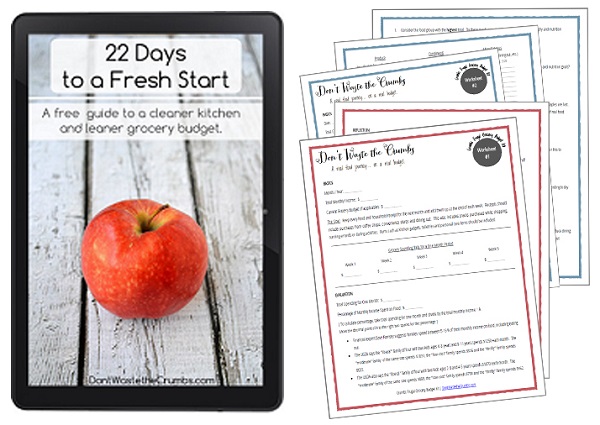
That’s why I created the 22 Days to a Fresh Start series. I wanted others to learn from my mistakes and know that it IS possible to eat real food by making small strides in the right direction, and that it IS possible to do it without going broke!

Eating real, wholesome food is certainly not an overnight magic trick … It’s about making better choices, one at a time, based on your own family’s needs and budget. And this, of course, looks different for each one of us.

The key is to start with one healthy eating goal and work to accomplish it before moving on to the next goal. Here are just a few ideas to consider as you begin setting your own goals for eating healthier and saving money!

Lemondrop-cupcakesMake a commitment to eliminate processed sugar
and instead use healthier all-natural sweeteners to
make wholesome and economical homemade treats.

183893_167625233290232_152814431437979_391626_2579529_nSave money and improve your gut health by making your own
homemade yogurt (it may sound intimidating,
but my heating pad method is fail proof!)

163762_157050237681065_152814431437979_330398_4776257_nSave big bucks by carving whole chickens yourself
and making your own homemade bone broth.

Tortilla SoupReplace one meal each week with a healthy satisfying soup
like my tortilla soup or hearty minestrone.
(You’ll be amazed at how much money you save by
serving soup once a week, especially if you eat your leftovers.)

So I encourage you to set a goal to do your first something right now. Arm yourself with knowledge and read Kelly’s write up on what real food is and her tips on how to set healthy living goals and make a budget. Fill your pantry with one or two of these awesome real food essentials, instead of buying another pre-packaged, processed food. You can also sign-up for my free newsletter to learn more about how to prepare healthy nourishing food, while also maintaining a healthy budget.  And as a thank you, you’ll be able to download the entire 22 Days to a Fresh Start series in an easy-to-read PDF format.

Remember, even the smallest steps in the right direction are progress. Just start by doing something and soon you’ll find yourself making great strides with your healthy eating goals!

Meet TiffanyMeet Tiffany!
Tiffany is a newbie real food eater who is trying to master real foods and incorporate them into her kitchen without breaking the bank. She documents her baby-sized strides at Don’t Waste the Crumbs and Google.

You Might Also Like:

The Secret of Success: “Mise en Place!”


Ever wonder how those famous chefs on Food Network seem to whip up amazing meals in what seems like mere minutes?

Well, believe it or not, getting a great meal on the table quickly and effortlessly isn’t just about talent or experience. The real secret to increasing your efficiency and success in the kitchen is to commit to some good ol’ fashioned planning and organization in the form of “mise en place.” (Of course, having a team of sous chefs doesn’t hurt either.)

I remember the first time I heard about mise en place – it was Julia Child speaking in her distinctly unusual accent, telling me and all her PBS viewers that there was nothing more efficient than practicing mise en place.

I was enlightened, I was thrilled, I knew life in the kitchen would never be the same again … after all, I now knew a secret that renowned chefs across the globe utilized to increase efficiency and ensure the success of their culinary creations.

Mastering “Mise En Place”
“Mise en place” (pronounced MEEZ ahn plahs) is a French culinary term that means “to put in place.” In a nutshell, the purpose of mise en place is to have all of your ingredients prepared and ready to go before you start cooking, so you don’t have to stop during the cooking process to do anything other than add the next ingredient.

Trust me, friends … if you adopt the practice of mise en place, you will find life in the kitchen not only quicker and easier, but more successful and enjoyable too!

Mise en place will truly help you to be a better cook, guaranteed! Why? Because you will be able to focus your attention fully on the most critical aspect of what makes a meal a success – cooking.

Let’s Get Started!
There are two simple steps when it comes to mise en place:
• Planning ­– making sure you have all of the ingredients (and necessary tools) called for in a recipe before you get started, and
• Organizing – making sure you have all of the ingredients prepared (ready to go) before you start cooking.

Step One: Planning
Have you ever come home from a busy day and starred blankly into the refrigerator or pantry hoping for divine inspiration on what to make for dinner, only to find that when inspiration finally strikes, you’re missing one of the essential ingredients needed to make the meal? I admit that I had this experience almost daily before I got serious about weekly meal planning.

Honestly, there’s no better way to ensure that you have all of the ingredients on hand to make a recipe, than to practice the time-saving and money-saving strategy of meal planning! In fact, may I be so bold as to suggest that meal planning is the ultimate mise en place!

Meal planning not only guarantees that you’ll have all of the ingredients necessary to execute every recipe on your meal plan, but it also helps to save time, stress and money because you’ve already pre-planned what you’ll be cooking for the week. For details, please check out “Mastering Meal Planning.”

Step Two: Organizing
I think it’s safe to say that most of us wouldn’t pack a suitcase by simply opening it up and filling it with random socks, shirts, pants, shoes, etc. First, we’d plan what we’re going to wear. Then we’d start organizing and assembling all of the necessary components before we packed the suitcase.

Successful, efficient cooking isn’t much different – by planning ahead in the form of weekly meal planning (as discussed above), you’ll already have what you need for each recipe you’ll be making. This makes it much easier to take the next step of mise en place – organizing!

If you’ve watched any cooking show on TV, you’ve seen the results of the behind-the-scenes organization that has taken place – all those little bowls of ingredients already pre-prepped and ready to go for the chef. All the chef has to do is talk you through the recipe as he/she adds each perfectly prepped and measured ingredient.

It would be awesome to have a personal sous chef to prep and assemble all of your recipe ingredients, but the fact is you can still benefit from this practice, you just have to commit to Be Your Own Sous Chef! Or better yet, train up little sous chefs to help you!

Mise en Place in Action!
Ready to be a “Real” Food Network Star in your own home? Below are some of my favorite mise en place tips to help you get organized before you start cooking:

• Gather all of the ingredients, as well as all of the measuring tools and cooking tools, etc. that are needed to execute the recipe(s) and place them close at hand. (Even better is to organize them in the order you’ll be using them.)

• Dice, chop, grate, mince, etc. all of the ingredients needed for the recipe(s) so they’re all ready to go before you start cooking.

• Premeasure out ingredients in individual prep bowls or measuring cups. (Or group them together in one bowl, if you’re going to add them at the same time to a recipe.) You don’t have to measure out everything, just those ingredients that would cause you to hold up progress. (For example, when baking, I never pre-measure out vanilla extract, but I always pre-measure out things like yogurt, honey, maple syrup, etc.)

• Clean as you go … another great benefit of mise en place is less mess to clean-up after cooking. Since you’re spending time prepping before you start cooking, you can also take a minute to clean-up a bit after prep-time is completed, before you start cooking. This is especially rewarding if you’re having dinner guests – not only so your kitchen appears tidy when guests arrive, but also so you can relax after dinner, rather than having to look forward to a lengthy clean-up progress.

Timing is everything – If you’re going to be cooking or assembling more than one dish, it’s important to start with the recipe items that take longer to cook and then work your way to those ingredients or dishes that take less time to prepare. This strategy helps you to develop good timing – so everything is ready all at the same time!

• Schedule a “Mise en Place” Prep Day! If you meal plan, a great time-saving strategy is to schedule a prep day so you can prepare for the week ahead by pre-cutting and marinating meats; chopping veggies, such as lettuce for quick and easy salads; making and freezing key ingredients (or meals) that can be defrosted later for quicker meal assembly. The ideas for prepping in advance are endless! That’s why prep days are a great mise en place strategy – they help reduce your time in the kitchen during the rest of week, so you can still provide healthy homecooked meals even on the busiest of days.

A Final Mise en Place Tip
Let’s talk about preheating for a minute. This is one of the most often overlooked mise en place strategies.

There’s a reason a recipe calls for preheating – it helps to ensure the food cooks properly. So before just throwing a steak on a barely heated grill (for example), be sure to preheat the grill, so it’s nice and hot. A hot grill helps to sear the exterior of the meat and lock in its juices, making the steak so much more tender and juicy!

Similarly, before sautéing, be sure your pan is well heated. By allowing time for your pans to heat-up before cooking, you’ll help to ensure better, tastier results.

Additionally, when cooking with oil, it should be close to its smoking point, before you add your recipe ingredients for best results.

And it probably goes without saying, that before you put those homemade cookies or muffins in the oven, it’s wise to be sure that your oven is preheated to the precise baking temperature called for in the recipe. Otherwise, you may end up with burned bottoms (and nobody likes a burned bottom).

Investing Your Time Wisely!
I promise, practicing mise en place isn’t just for famous TV chefs and restaurateurs, it’s a proven technique that can help everyone to cook with more ease and more success. That’s because mise en place helps us to invest our time wisely!

So remember the secret – Putting in the necessary time upfront to plan your meals and then, gather and prep all of the recipe’s ingredients in advance, helps to ensure that the time you spend cooking is much more efficient and enjoyable, as well as results in a healthy and delicious meal for the family you love!

Joyfully Serving Him, Kelly

This post was shared at: Better Moms Monday Link-UpHomestead Barn HopWelcome Home MondaysModest MondaysHomemaking Link-Up; Works for Me Wednesday; Gluten-Free Wednesday; Allergy-Free Wednesdays; Real Food Wednesday; Living Well WednesdaysPennywise PlatterSimple Lives Thursdays; Freaky Friday; Fresh Bites Friday; Fight Back FridayFeasting in Fellowship Fridays and Whole Foods Wednesday.

You Might Also Like: